
 United StatesJFK
 MexicoMEX
 BrazilGRU
 ArgentinaEZE
 ChileSCL
 ColombiaBOG
 PeruLIM
 PanamaPTY
 Costa RicaSJO
 Dominican RepublicPUJ
 JamaicaMBJ
 BahamasNAS
 BarbadosBGI
 United KingdomLHR
 IrelandDUB
 FranceCDG
 GermanyFRA
 NetherlandsAMS
 BelgiumBRU
 SwitzerlandZRH
 AustriaVIE
 ItalyFCO
 SpainMAD
 PortugalLIS
 GreeceATH
 TurkeyIST
 DenmarkCPH
 SwedenARN
 NorwayOSL
 FinlandHEL
 PolandWAW
 Czech RepublicPRG
 HungaryBUD
 IcelandKEF
 United Arab EmiratesDXB
 QatarDOH
 Saudi ArabiaRUH
 IsraelTLV
 EgyptCAI
 MoroccoCMN
 South AfricaJNB
 KenyaNBO
 NigeriaLOS
 IndiaDEL
 PakistanLHE
 Sri LankaCMB
 SingaporeSIN
 MalaysiaKUL
 ThailandBKK
 VietnamSGN
 PhilippinesMNL
 IndonesiaCGK
 Hong KongHKG
 ChinaPVG
 TaiwanTPE
 JapanHND
 South KoreaICN
 AustraliaSYD
 New ZealandAKL
The first decision on a normandy d-day beaches private tour with driver is not which beach to see. It is how many stops one day can honestly hold. The Calvados coast is spread out, the sites are serious places that deserve time, and the roads between them are ordinary country roads. A chauffeur who knows the order of the day makes the difference between three stops done well and six done badly.
If you are traveling by private car, three questions matter: how to get to the Normandy D-Day beaches by car from Paris, Caen and Bayeux, what is open or under works in 2026, and how to sequence a full day.
How far are the D-Day beaches from Paris by car?
Bayeux, the usual base for the British, Canadian and American sectors, is about 260 to 270 km (160 to 170 miles) from Paris, roughly three hours via the A13 and the N13. From Bayeux, Omaha Beach is about 22 to 24 km (14 to 15 miles), around 20 minutes.
The A13 runs from the Paris ring road to the Caen ring road, a distance of about 225 km, and then the route follows the N13 west to Bayeux. Plan three hours in light traffic and more on Friday evenings, when Parisians leave for the coast. Caen, with the Memorial museum, sits about 40 minutes from Arromanches and is the natural stop for visitors arriving by ferry from Britain.
Guests landing in France can start at Paris Charles de Gaulle, and the Paris chauffeur service page explains how a Paris pickup works. For a one-day visit from Paris the day is long: roughly six hours of driving for about six hours at the sites. Most guests stay one night in Bayeux or Caen, which turns the same program into two comfortable days.
Why go with a private driver rather than a coach or rental car?
The beaches are not a single attraction. They are a chain of memorials, museums, cemeteries and open ground, run by different bodies: the American Battle Monuments Commission, the Mémorial de Caen, municipal museums, local associations. No train line serves them, and the bus network is thin outside Bayeux. A rental car works if you enjoy navigating hedgerow lanes and finding parking at each stop; a coach tour sets the pace for you.
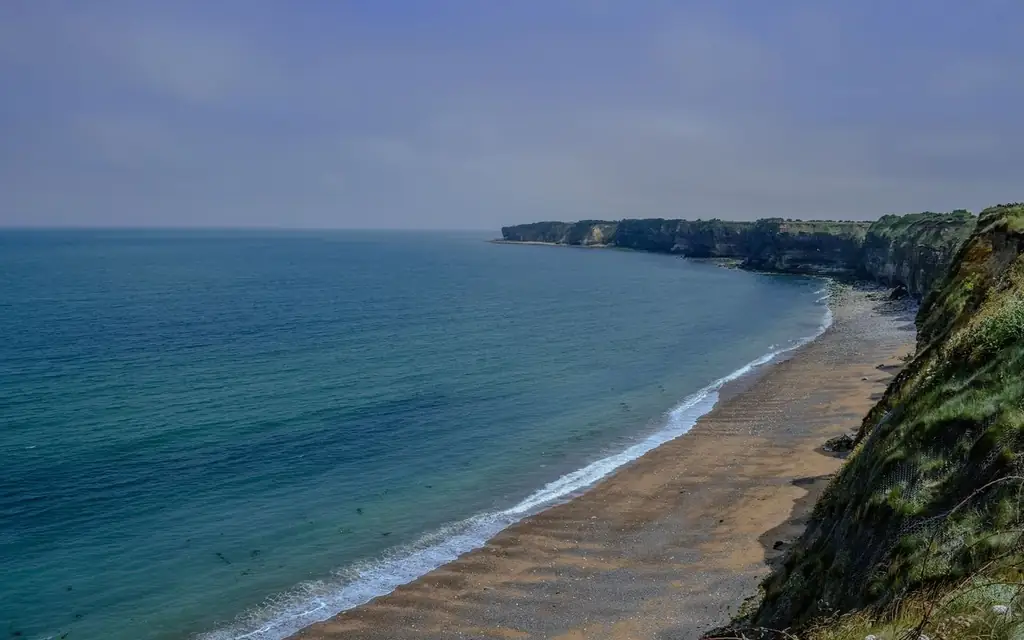
A private driver sits between the two. You decide how long to stand in the cemetery, the chauffeur finds the car park, and the day can change shape when a site is crowded or the weather turns. One caution: a chauffeur drives and can suggest stops, but a battlefield guide who tells the story of each sector is a separate professional. If you want one, mention it to the desk and the driver will meet the guide at the first stop.
What is open, and what is not, in 2026?
Check these four before you set the date.
- Normandy American Cemetery, Colleville-sur-Mer. The American Battle Monuments Commission lists the cemetery as open 9 a.m. to 5 p.m., with last admission at 4:30 p.m., closed on 25 December and 1 January. Admission is free and does not currently require advance booking. Guided tours run in English at fixed times, 11 a.m. and 2 p.m. from April to September and 2 p.m. from October to March, according to the local tourism office. The footpath from the cemetery to Omaha Beach has been closed since 2016; public beach access is nearby.
- Pointe du Hoc. The Rangers' cliff-top site is under a major preservation project from 2026 to mid-2027, led by the ABMC. Normandy's tourism board says the site stays open and free, that parking on site is free and a visit takes about an hour, but that some areas may be closed, the visitor center building is closed and the introductory film is shown outdoors. Guided tours are still offered.
- Mémorial de Caen. The museum lists a full visit at about four hours. For 2026 it is closed on 4, 18 and 25 November and 2, 9 and 16 December, and the October to December opening hours are not on the page, so check them when you book.
- Bayeux Tapestry. The museum in Bayeux is closed for renovation until autumn 2027. Do not build a day around it; the town itself remains worth an hour on foot.
The Caen museum sells tickets through its website, with on-site sales closing 1 hour 15 minutes before closing time, and the site is available in English. Dates and hours change, so verify against the ABMC page for the Normandy American Cemetery, the Normandy tourism page for Pointe du Hoc and the Caen Memorial site.
The sequence that works: east to west or west to east?
The beaches run in a line. From east to west the order is Sword, Juno and Gold, then Omaha, then Utah on the Cotentin side. Arromanches, the former Gold sector harbor town, and Omaha with its cemetery are where most visitors stop.
A reliable one-day order from Bayeux:
- Arromanches (20 minutes from Bayeux). Park near the sea front, walk to the viewpoint over the remains of the Mulberry harbor, and consider the Arromanches 360 circular cinema, which sits on the clifftop and is run by the Mémorial de Caen. Go early, before the coaches arrive.
- Omaha Beach and the American Cemetery (about 20 minutes further west). This is the emotional center of most itineraries. Allow at least an hour and a half at the cemetery alone.
- Pointe du Hoc (about 15 km, or 9 miles, west of the cemetery). The site has the craters, the bunkers and the cliff, and even with the works under way it is worth the stop. Allow an hour.
- Return via Bayeux or continue to Utah Beach and Sainte-Mère-Église if you are staying on the Cotentin side. That adds time; treat it as a second day.
If your priority is the British and Canadian sectors, reverse the day toward Juno and Sword, and make the Caen Memorial the anchor stop. A chauffeur can swap the order in minutes when you tell us your emphasis.
Where can the car stop, and how do visitors move on foot?
Parking is straightforward compared with the Mont-Saint-Michel: at the American Cemetery the entrance is signposted from the road toward Colleville-sur-Mer, and at Pointe du Hoc there is a free car park on site. Arromanches has municipal pay parking close to the clifftop cinema. Along the Omaha Beach road, expect small roadside car parks that fill earlier in summer than in autumn.

The cemetery is a burial ground, and the ABMC asks visitors to behave with respect and solemnity. There is no printed dress code, but beachwear and loud conversation are out of place. Staff are on site in the visitor building to answer questions and to help families locate graves, and a request in advance is the right route for a specific grave or a wreath-laying.
For a chauffeured day, the car parks are where the driver waits. At Colleville, you walk from the car park to the entrance, and the driver does not need to follow.
Best day, best season and the 6 June factor
April to June and September offer the best mix of light and manageable crowds. July and August are busy but workable if you start early. The anniversary of the landings on 6 June brings commemorations, road closures and a surge of visitors across the coast; if you are not attending a ceremony, plan around it. October and the early winter months are quiet, with early sunsets that shorten the day. Weekday mornings are the calmest hours throughout the year.
The coast is also exposed. Wind and rain can arrive off the Channel in any month; pack layers and waterproof shoes. Tidal timing matters only if you plan to walk the beach itself, where the low tide gives a long stretch of sand and the high tide very little.
How long to allow
A balanced program of Arromanches, Omaha with the American Cemetery, and Pointe du Hoc takes about eight hours door to door from Bayeux, including lunch. Adding the Mémorial de Caen means a second day: the museum alone is about four hours, and it sits on the far side of Caen. Many guests give the Caen Memorial a morning, then drive the coast the following day.
If you only have half a day, choose two stops, not four: the American Cemetery and Omaha Beach for a first visit, or Arromanches and the Mulberry harbor viewpoint if you want a lighter day with children. A short program done calmly is a better memorial than a rushed long one, and the chauffeur can return you to Bayeux or Caen by early afternoon.
Getting there: private car, train, coach or rental
| Way to go | Road time | Cost note | Suits |
|---|---|---|---|
| Private chauffeur from Paris | About 3 hours to Bayeux, 260 to 270 km (160 to 170 miles) | Fixed fare via the booker | Families, small groups, a flexible day |
| Train to Bayeux, then taxi | Rail to Bayeux, then 20 minutes by road to Omaha | Moderate | Independent travelers staying in Bayeux |
| Small-group coach tour from Paris | Full day, long hours | Per-person price | First-timers who want a set script |
| Rental car | 3 hours from Paris, then local driving | Variable, plus fuel and parking | Confident drivers with time |
| Local bus from Bayeux | Limited schedule | Lowest | Single-site visits on a tight budget |
The honest summary: the train to Bayeux is a good, inexpensive way to reach the area if you plan to base yourself there. The private car wins when you want to see several sites in a single day without being tied to bus times. The Executive Sedan and First Class Sedan take up to three passengers, the Luxury SUV up to six, and the Sprinter up to 12 to 14 for family or group days.
Pairing the beaches with other Normandy stops
The beaches sit in a region packed with sites. Mont-Saint-Michel lies roughly 150 km (93 miles) to the southwest and is the usual companion for a three-day Normandy circuit. Giverny and Monet's garden sits on the Paris side of the A13 and fits an out-and-back journey, and the Palace of Versailles is a natural start to a western departure from the capital. For a wider regional picture, see the Europe directory and our private tours with driver overview.
How the booking works
Reservations go through the 24/7 desk at LimousineWorldwideDirectory.com. The chauffeur is a vetted, licensed and commercially insured local operator from our directory; the desk confirms the booking and issues one invoice. Put your Bayeux or Paris pickup and your first stop in the booker and the fixed fare appears before you pay. Child, toddler and booster seats are an add-on at booking, and most vehicles carry water and phone chargers.
Frequently asked questions
How far is Omaha Beach from Paris by car?
About 285 to 295 km (177 to 183 miles) by road, around three and a half hours, because Omaha lies roughly 22 to 24 km (14 to 15 miles) beyond Bayeux. The A13 and N13 are the main route.
Is the Normandy American Cemetery free to visit?
Yes. The American Battle Monuments Commission lists admission as free, with no advance booking currently required. Hours are 9 a.m. to 5 p.m., with last admission at 4:30 p.m., and the cemetery is closed on 25 December and 1 January.
Is Pointe du Hoc open in 2026?
Yes, with limits. The site remains open and free, but a restoration project runs from 2026 to mid-2027. The visitor center building is closed, the introductory film is shown outdoors, and some areas may be closed. Check the ABMC and Normandy tourism pages before you go.
Can I see the Bayeux Tapestry on a D-Day tour?
Not currently. The Bayeux museum is closed for renovation until autumn 2027, so build the day around the coast and the Caen Memorial instead.
How long does a D-Day beaches tour take?
A day with Arromanches, Omaha and the American Cemetery, and Pointe du Hoc takes about eight hours from Bayeux. The Caen Memorial needs about four hours on its own, so most guests give it a separate half day.
Is there a dress code at the American Cemetery?
No specific dress code is printed, but the cemetery is a burial ground and visitors are asked to behave with respect and solemnity. Dress modestly and keep voices low.
Do I need a guide as well as a driver?
A chauffeur drives and can suggest stops. A battlefield guide who explains each sector is a separate professional; tell the desk if you want one and the driver can meet the guide at your first stop.
Which beach should I see first?
For a first visit, most travelers choose Omaha Beach with the Normandy American Cemetery, then Arromanches for the view of the Mulberry harbor remains. Pointe du Hoc adds the cliff and craters, though parts are closed during the 2026 to 2027 works.
Can I do the D-Day beaches in one day from Paris?
It is possible but long: about six hours of driving and six at the sites. Most guests prefer to stay a night in Bayeux or Caen.