 United StatesJFK
 MexicoMEX
 BrazilGRU
 ArgentinaEZE
 ChileSCL
 ColombiaBOG
 PeruLIM
 PanamaPTY
 Costa RicaSJO
 Dominican RepublicPUJ
 JamaicaMBJ
 BahamasNAS
 BarbadosBGI
 United KingdomLHR
 IrelandDUB
 FranceCDG
 GermanyFRA
 NetherlandsAMS
 BelgiumBRU
 SwitzerlandZRH
 AustriaVIE
 ItalyFCO
 SpainMAD
 PortugalLIS
 GreeceATH
 TurkeyIST
 DenmarkCPH
 SwedenARN
 NorwayOSL
 FinlandHEL
 PolandWAW
 Czech RepublicPRG
 HungaryBUD
 IcelandKEF
 United Arab EmiratesDXB
 QatarDOH
 Saudi ArabiaRUH
 IsraelTLV
 EgyptCAI
 MoroccoCMN
 South AfricaJNB
 KenyaNBO
 NigeriaLOS
 IndiaDEL
 PakistanLHE
 Sri LankaCMB
 SingaporeSIN
 MalaysiaKUL
 ThailandBKK
 VietnamSGN
 PhilippinesMNL
 IndonesiaCGK
 Hong KongHKG
 ChinaPVG
 TaiwanTPE
 JapanHND
 South KoreaICN
 AustraliaSYD
 New ZealandAKL
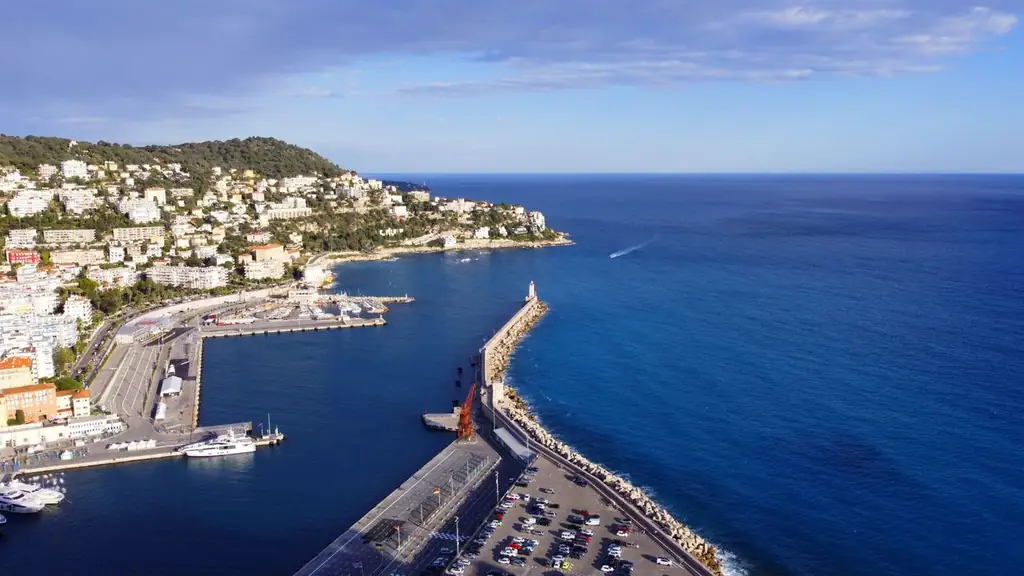
Most landmarks are a point on the map. The Promenade des Anglais is a line, roughly seven kilometers long, that begins beside the runway of Nice Côte d'Azur Airport and ends below the rock of the Colline du Château. That shape changes how you plan a Promenade des Anglais private tour with driver: the question is not where to park, but which part of the line you want, in which direction, and at which hour. This guide splits the seafront into its western, central and eastern stretches and tells you what a car can and cannot do on each.
How do you get to the Promenade des Anglais from Nice airport?
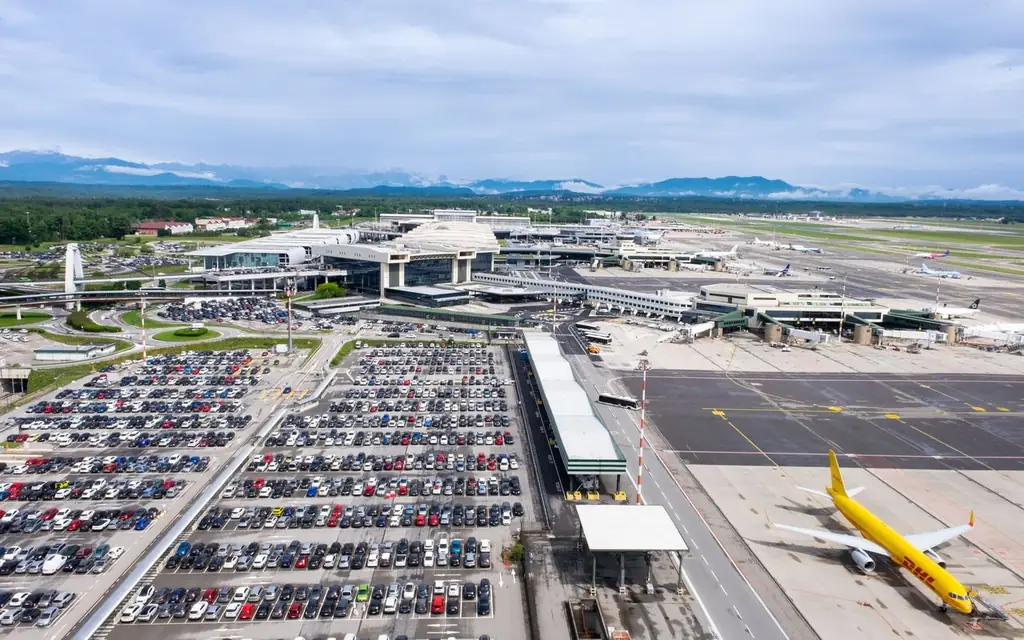
Nice Côte d'Azur Airport sits at the western end of the promenade, so the route is short: about 6 to 7 km (4 mi) to the city center, roughly 15 to 25 minutes by car outside rush hour. The tram also runs from both terminals to the center in under 30 minutes.
The airport's own site, nice.aeroport.fr, describes tram line 2 running from Terminal 1 and Terminal 2 to the city center, stopping at Jean Médecin and Port Lympia, in less than 30 minutes, with a tram every 7 to 8 minutes on weekdays. A free tram links Terminal 2, Terminal 1 and Grand Arénas. If you have luggage, a late flight or more than two people, a car is simpler. Enter your terminal and hotel in the booker; the fare is shown before you confirm.
What the promenade is, in one paragraph
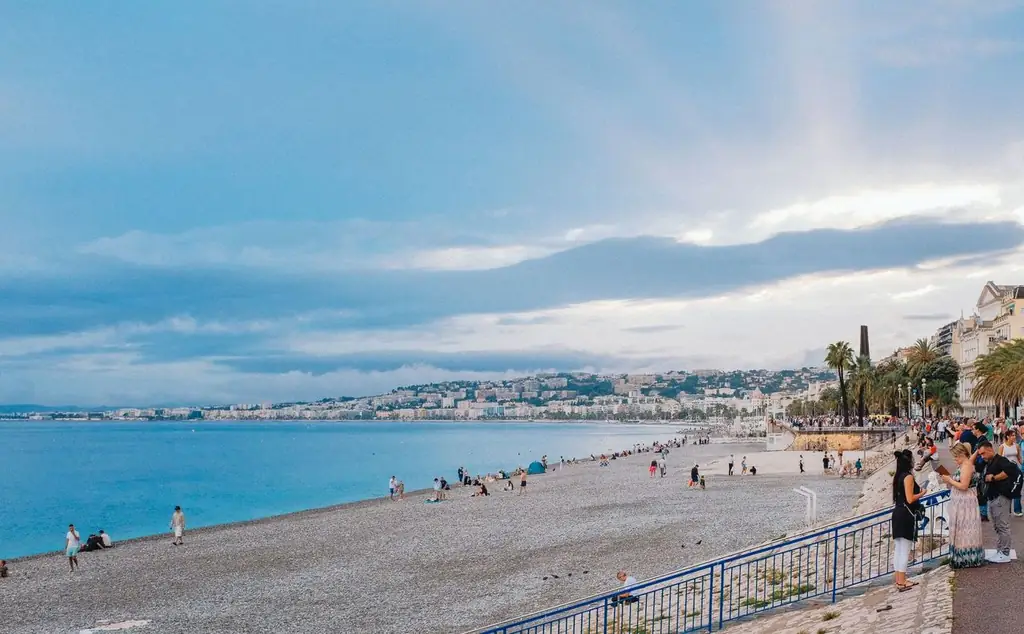
The city's tourism site describes it as a seafront path of roughly seven kilometers along the Bay of Angels, open every day of the year, free to enter, and the setting for events such as the Nice Carnival. Its history starts in the 1820s, when a British clergyman encouraged the building of a shoreline path to give local people work after a harsh winter; British winter visitors adopted it, and the city named it in their honor. You can read the city's version at explorenicecotedazur.com.
The western end: airport, Arénas and the first kilometers
Leave Terminal 2 or Terminal 1 and the road immediately becomes the promenade. This end is the least photographed and the most practical, and it is where conference guests and Monaco-bound travelers join the seafront traffic.
For a chauffeured guest the western end matters in two ways. The first is arrivals: pick-ups at the terminals, and the free tram that links Terminal 2, Terminal 1 and Grand Arénas, are all here. The second is the congestion pattern. Traffic from the A8 motorway and the airport converges on the seafront at the morning and evening peaks, and a flight that lands at 08:30 can meet commuter traffic within ten minutes of leaving the terminal. If your flight is international, our desk tracks it and the free waiting time is 60 minutes after landing; for domestic arrivals it is 30 minutes.
The middle: palm trees, grand hotels and the blue chairs
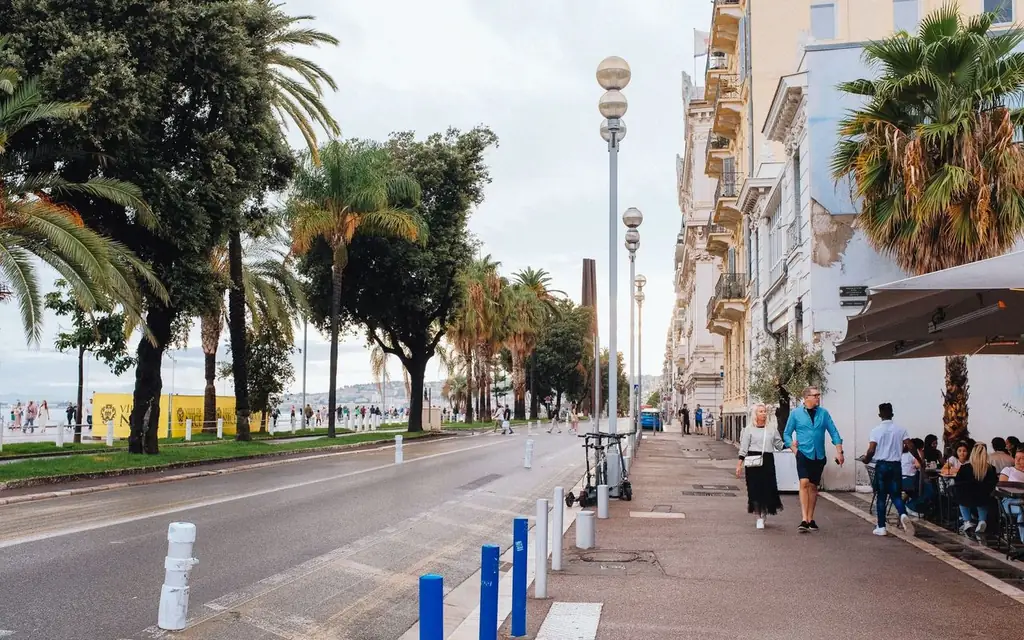
In the central stretch the promenade is what the postcards show: palms, a wide pavement, rows of the famous blue chairs facing the water, and the grand hotels of the Belle Époque. The Hôtel Negresco, with its pink dome, dates from 1913 and remains the best landmark for giving a chauffeur a pick-up point.
On this part of the seafront, stopping is limited. The carriageway carries heavy traffic, and a car does not linger. A realistic plan is to use a hotel forecourt, a side street or an underground car park a block back from the water, and walk to the seafront. Tell the driver where you want to be collected; "in front of the Negresco" is less useful than "the side street by the hotel's rear entrance," because a clear instruction lets the driver arrive without circling.
Walking is the point of this stretch. The pavement is wide, the sea is on one side, and the route is flat, so most guests can walk it. A comfortable stroll covers about two kilometers in forty minutes without stopping.
The eastern end: Quai des États-Unis, Castle Hill and the old town
As the promenade swings east, it becomes the Quai des États-Unis, running to the foot of the Colline du Château. The old town, Vieux Nice, lies behind it, and Cours Saleya, the flower and produce street, is the common lunch stop. The hill itself can be climbed on foot or by lift for a view back over the whole bay.

Cars cannot enter the pedestrianized lanes of the old town. A chauffeur drops at the edge near Place Masséna or on the quai and collects you at the same point. If you are carrying shopping or have a mobility issue, say so when booking so the driver can arrange a closer stop. The Albert I garden and the Promenade du Paillon, a long park that leads inland from the coast, are the gentlest ways to reach the old town from the seafront on foot.
A short history that makes the walk better
The first path was a narrow strip along the shingle, built in the early 1820s after a hard winter left many workers in the city without income. It was widened and paved as more winter visitors arrived, and by the later nineteenth century it was a fashionable promenade lined with villas. After the annexation of Nice to France in 1860 the name changed from the local Niçois form to the one we use now. The twentieth century widened it again to take cars and trams, and the present road is the result.
The point for visitors is that the promenade is a working city street as much as a monument. Joggers, cyclists, skaters and delivery vans share it. Nice treats it as a civic space, and it is the setting for public events and commemorations.
A note on remembrance
The city keeps memorials to the victims of the 14 July 2016 attack, and holds ceremonies each year. If you are walking there, treat these places quietly. Chauffeurs on this route are used to guests who want a few minutes alone, and the desk can plan an unhurried stop.
Giving a clear pick-up point
A seven-kilometer street invites vague instructions, and vague instructions cost minutes. These habits help:
- Name a cross street or a hotel entrance, not "the promenade". The driver can then approach from the right direction and avoid a U-turn on a busy carriageway.
- Say which direction you will be walking. If you plan to stroll from west to east and be collected at the Quai des États-Unis, tell the desk and the confirmation will carry the meeting point.
- Share a mobile number that works abroad. Our desk is open 24/7 and relays messages, but a direct line to the driver is quicker when a street is blocked.
- Allow ten minutes of margin at the evening peak; a drive of 2 km can take longer than the walk.
Evenings are the other side of the promenade. After sunset the lights come on along the bay, the beach restaurants fill, and the pavement is full of families. It is a good place for a slow dinner walk, and a car can wait at a nearby hotel or car park while you eat.
Guests who plan an evening on the seafront and a late return to a hotel outside Nice can book the return leg at the same time as the outbound transfer, so the fare for both is shown together and the driver is already assigned.
Think about the direction of the walk. Walking from the Negresco toward the Quai des États-Unis ends at the old town and Castle Hill, where lunch is easy and the car can wait on the quai. If the sun is strong, start early and keep the second half of the stroll for the evening, when the pavement cools and the light softens. A driver can follow along the road and meet you wherever you decide to stop, as long as you name a cross street rather than a stretch of seafront.
Seasons, events and what changes the traffic
- February: the Nice Carnival is held on the Riviera in winter and the city names the promenade as a setting for it. Expect road closures, allow extra time and confirm the route with the city for the dates.
- Spring and autumn: the best walking weather, with softer light and fewer crowds.
- Summer: hot, busy and full of beach traffic. Midday is hard for walking; the evening is better.
- Winter: mild but quieter; some beach concessions close.
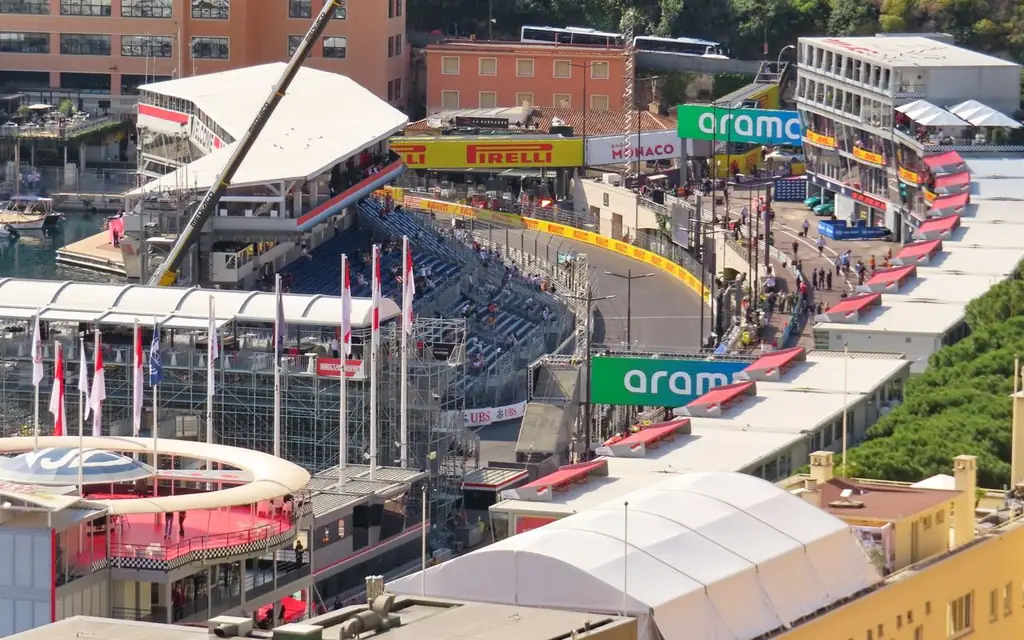
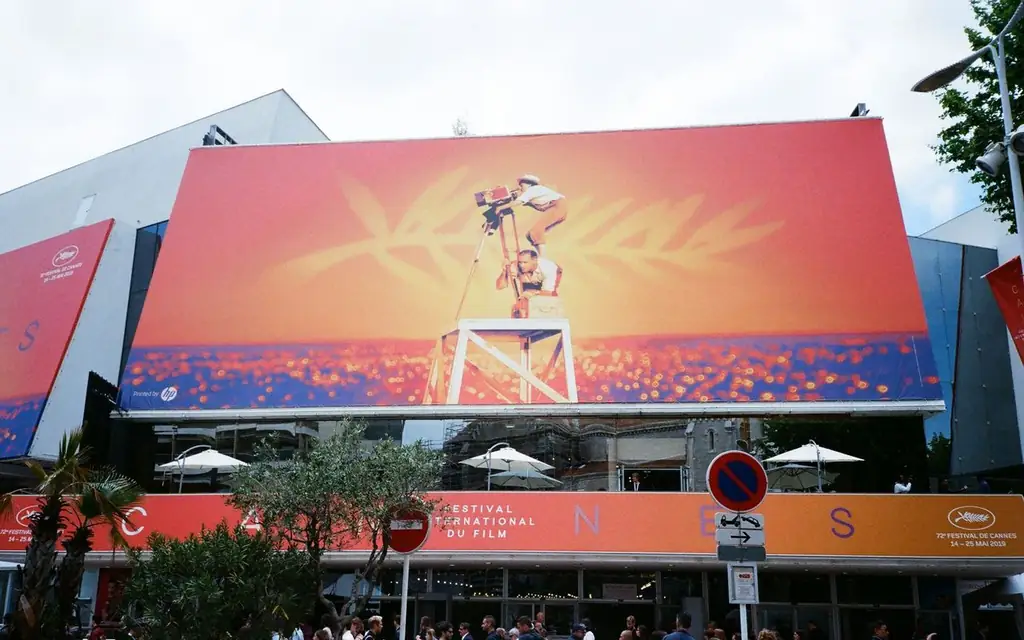
When a large event closes lanes, the driver adjusts the route and meeting point. The desk will tell you on the confirmation if an event is likely to affect your pick-up. The Cannes Film Festival and the Monaco Grand Prix both put pressure on the coastal roads; our pages on the Cannes Film Festival and the Monaco Grand Prix explain how to plan around them.
Ways to move along the promenade compared
| Option | Time airport to center | Cost note | Best for |
|---|---|---|---|
| Private chauffeur | About 15 to 25 minutes | Fixed fare via the booker | Luggage, groups, late arrivals |
| Tram line 2 | Under 30 minutes | Lowest | Light luggage, solo travelers |
| Taxi | About 15 to 25 minutes | Metered | Short hops without booking |
| Local bus | Slower | Low | Travelers without luggage |
| Walking | Not from the airport | Free | The promenade itself |
| Bicycle | Flexible | Low | Fit riders along the seafront |
For a single traveler with a carry-on, the tram is excellent: frequent, direct and the lowest in cost. The car wins when luggage, a hotel across town or a schedule is involved.
A chauffeured Riviera day starting on the promenade
A half or full day from Nice can reach the best-known stretches of coast without a train.
- 09:00. A walk on the promenade from the Negresco to the Quai des États-Unis, about forty minutes.
- 10:30. Vieux Nice and Cours Saleya, or a short lift ride up Castle Hill.
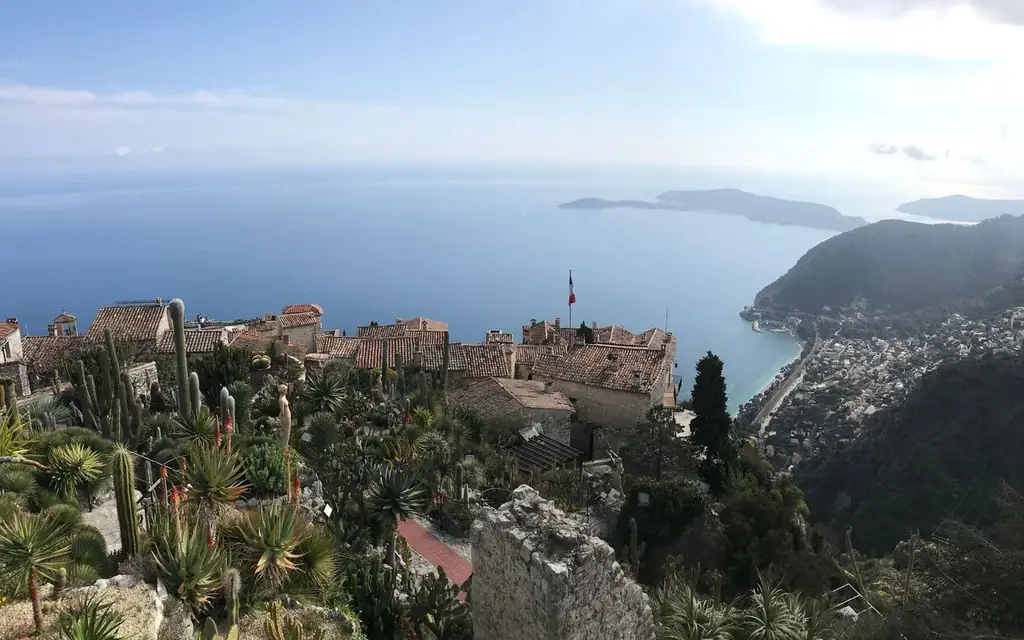
- 12:30. Èze, about 12 km (7.5 mi) east, 25 to 30 minutes by the Moyenne Corniche. See the Èze Village guide for the car park and garden hours.
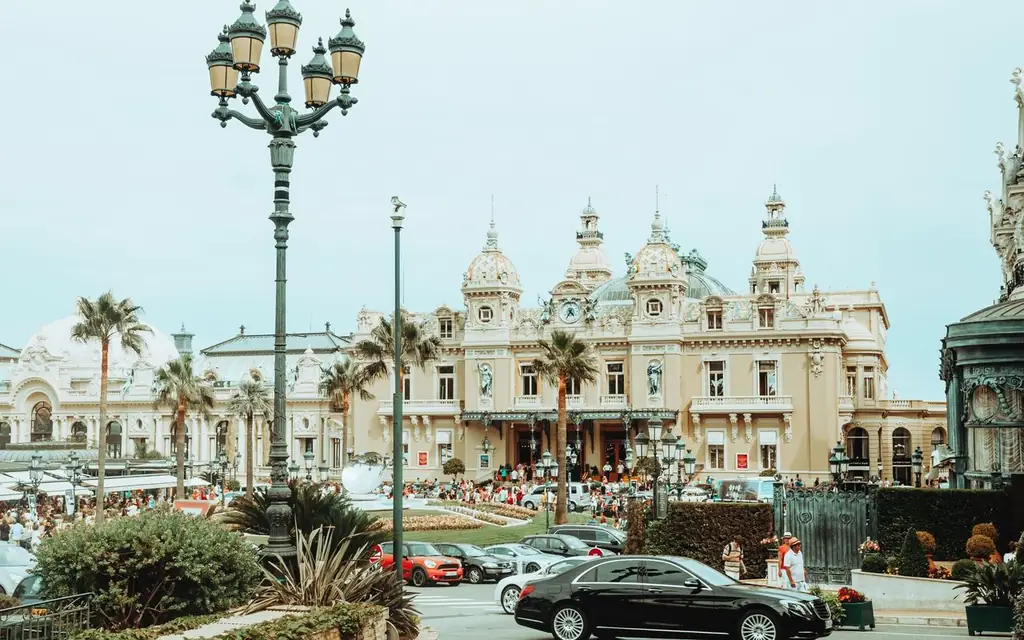
- 15:00. Monaco, about 20 km (12 mi) from central Nice, 25 to 40 minutes. The Monte-Carlo Casino guide covers the building's visiting rules.
- 18:00. Return along the coast.
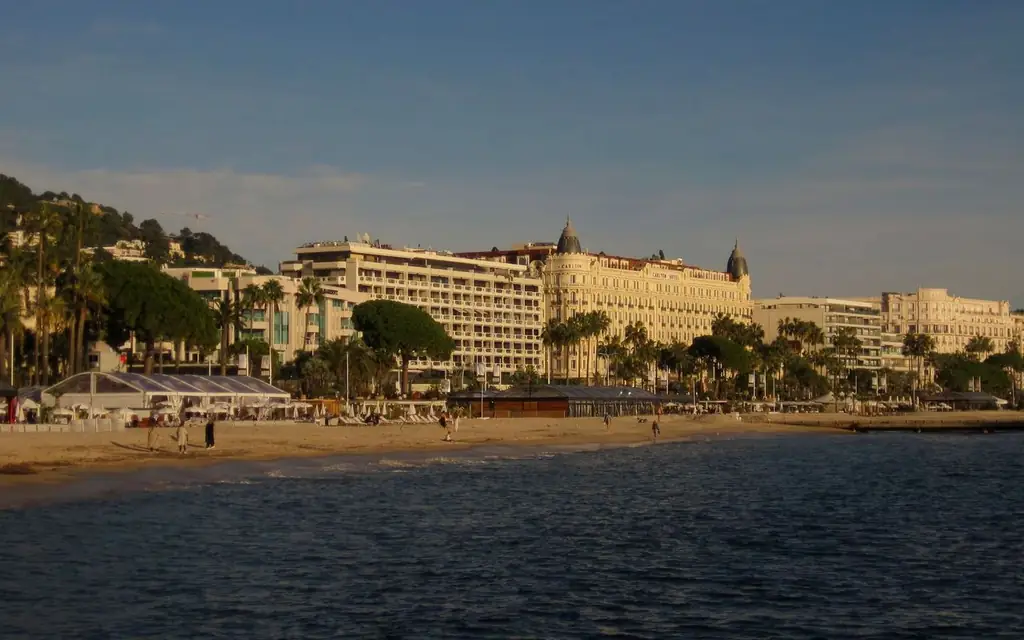
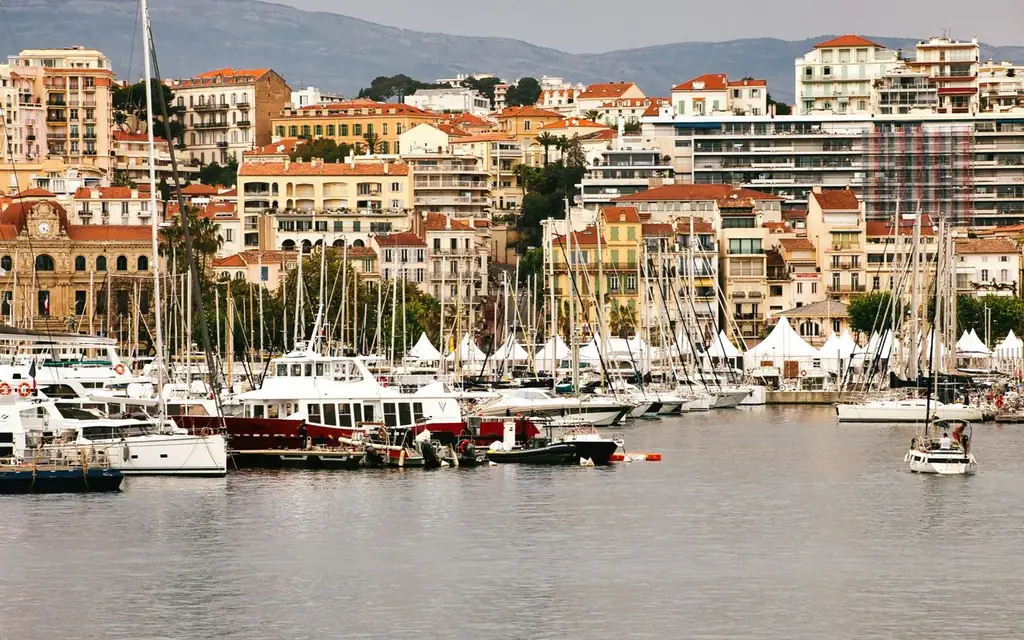
Going west instead, Cannes is about 30 km (19 mi) from Nice, 30 to 45 minutes by the A8, and the La Croisette guide picks up from there. For the longer run to the Gulf of Saint-Tropez, read the Saint-Tropez guide. All of these bases are served from the Nice and Monaco chauffeur service page, and the Nice Côte d'Azur private aviation page covers guests arriving on business jets.
Accessibility and comfort
The promenade is flat, wide and free, and the city lists it as open every day. There are no steps along most of its length, which makes it suitable for wheelchair users and strollers. Heat is the main hazard in summer: there is little shade, so carry water and a hat. Dogs are welcome, according to the city, and bikes share the route, so keep to the pedestrian side.
For guests who find a long walk tiring, ask the driver to drop at one end and collect at the other. The pavement is easy underfoot, and the car can follow along the road to meet you.
Official tourist offices and visitor bureaus can book chauffeur services for their visitors through a trade account with LimousineWorldwideDirectory.com. For wider planning, see the private tours with driver page and the Europe directory. The metropolitan tourist office at explorenicecotedazur.com lists events and visitor offices, and the airport's own site, nice.aeroport.fr, shows current terminal information.
Frequently asked questions
How far is the Promenade des Anglais from Nice airport?
The promenade begins at the airport's edge. The center of Nice is about 6 to 7 km (4 mi) away, roughly 15 to 25 minutes by car outside rush hour. The tram takes under 30 minutes.
How long is the Promenade des Anglais?
The city's tourism site describes it as roughly seven kilometers along the Bay of Angels. It runs from the airport end to the foot of Castle Hill, where it becomes the Quai des États-Unis.
Can a car stop on the Promenade des Anglais?
Not for long. Traffic is heavy and the road is a working street. A chauffeur normally uses a hotel forecourt, a side street or a car park nearby and meets you at a walking distance from the water.
Is the Promenade des Anglais free to visit?
Yes. According to the city's tourism site it is open every day of the year and access is free.
What is the best time to walk the Promenade des Anglais?
Early morning and evening, especially in summer. Spring and autumn are comfortable all day. In February the Carnival changes traffic and access, so check the schedule.
Is the tram or a private car better from the airport?
For one traveler with light luggage the tram is the lowest-cost, frequent and direct. A car is better with several bags, children, a late arrival or a destination away from the tram line.
How far is Èze or Monaco from the promenade?
Èze is about 12 km (7.5 mi) east of Nice, 25 to 30 minutes. Monaco is about 20 km (12 mi), 25 to 40 minutes depending on traffic.
Can I combine the promenade with a Riviera day trip?
Yes. A morning walk followed by Èze and Monaco, or Cannes in the other direction, fits a day. Ask the desk to time the legs for the season you travel.