
 United StatesJFK
 MexicoMEX
 BrazilGRU
 ArgentinaEZE
 ChileSCL
 ColombiaBOG
 PeruLIM
 PanamaPTY
 Costa RicaSJO
 Dominican RepublicPUJ
 JamaicaMBJ
 BahamasNAS
 BarbadosBGI
 United KingdomLHR
 IrelandDUB
 FranceCDG
 GermanyFRA
 NetherlandsAMS
 BelgiumBRU
 SwitzerlandZRH
 AustriaVIE
 ItalyFCO
 SpainMAD
 PortugalLIS
 GreeceATH
 TurkeyIST
 DenmarkCPH
 SwedenARN
 NorwayOSL
 FinlandHEL
 PolandWAW
 Czech RepublicPRG
 HungaryBUD
 IcelandKEF
 United Arab EmiratesDXB
 QatarDOH
 Saudi ArabiaRUH
 IsraelTLV
 EgyptCAI
 MoroccoCMN
 South AfricaJNB
 KenyaNBO
 NigeriaLOS
 IndiaDEL
 PakistanLHE
 Sri LankaCMB
 SingaporeSIN
 MalaysiaKUL
 ThailandBKK
 VietnamSGN
 PhilippinesMNL
 IndonesiaCGK
 Hong KongHKG
 ChinaPVG
 TaiwanTPE
 JapanHND
 South KoreaICN
 AustraliaSYD
 New ZealandAKL
What time can visitors enter the Sultan Qaboos Grand Mosque, and how do you get there?
Non-Muslim visitors are admitted in the morning only, Saturday to Thursday, from 8:00 or 8:30 to 11:00 depending on the source, with Friday closed. The mosque is about 12 to 17 km from Muscat International Airport, 15 to 30 minutes by car. A chauffeur arrives before opening and waits outside.
Everything about a sultan qaboos grand mosque private tour with driver is shaped by the clock. The mosque is a working place of prayer, and visits by non-Muslims are limited to a short window in the morning. Miss it and the next chance is the following day. A chauffeur does not change the opening hours, but a driver who knows the approach can make sure you are in the queue when the doors open, rather than stuck on the Sultan Qaboos Road with ten minutes to spare.
This guide covers the timing, the drive, what to wear, what the building contains, what to do with the rest of the morning and how to compare the ways of getting there.
The visiting window and the details to confirm
Sources give slightly different start times, so treat this as a range to check.
| Source | Days | Hours for non-Muslim visitors |
|---|---|---|
| Experience Oman | Saturday to Thursday | 8:00 to 11:00 |
| Ministry of Tourism guidance | Every day except Friday | 8:30 to 11:00 |
| One tour operator's notes | Saturday to Thursday | 8:00 to 11:00, last entry 10:30 |
Plan to arrive no later than 8:30 and ideally a little before, and aim to be inside by 10:00 at the latest. If last entry is 10:30, as one operator says, a 10:15 arrival is cutting it close.
The cost is another point to confirm. Experience Oman's page states an admission fee of 8 Omani rials, whereas older guides describe entry as free. The official Experience Oman page is the one to trust, and prices can change, so check it close to your travel date. We do not sell tickets, so this is a payment you make at the site or online as directed.
Closures for prayer, national holidays and special events can alter the schedule. Ask your hotel to phone ahead the day before, and tell your driver your fallback plan.
The drive from Muscat airport and from the hotels
Muscat International Airport sits west of the old city, and the mosque stands in the Bawshar area on the Sultan Qaboos Road, part of the main highway that runs through the capital. Sources put the road distance at about 12 to 17 km (7.5 to 10.5 miles) and the drive at around 15 to 30 minutes depending on traffic. That means a flight landing at 7:00 am can reach the mosque for the 8:30 opening, though you should leave margin for immigration and baggage.
From hotels on the Muttrah Corniche or in Old Muscat, the drive is longer but still comfortable. Morning rush hour on the main road is the variable. School runs and commuter traffic build up from about 7:00 am, and a pre-booked chauffeur who knows the slip roads helps.
We do not have a dedicated Muscat airport page, so see our airports hub for the airports we cover and the Middle East directory for the regional network. Book through the online booker with a flight arrival pickup so that the driver tracks the landing. International arrivals include 60 minutes of free waiting, which helps when immigration is slow.
What the building is
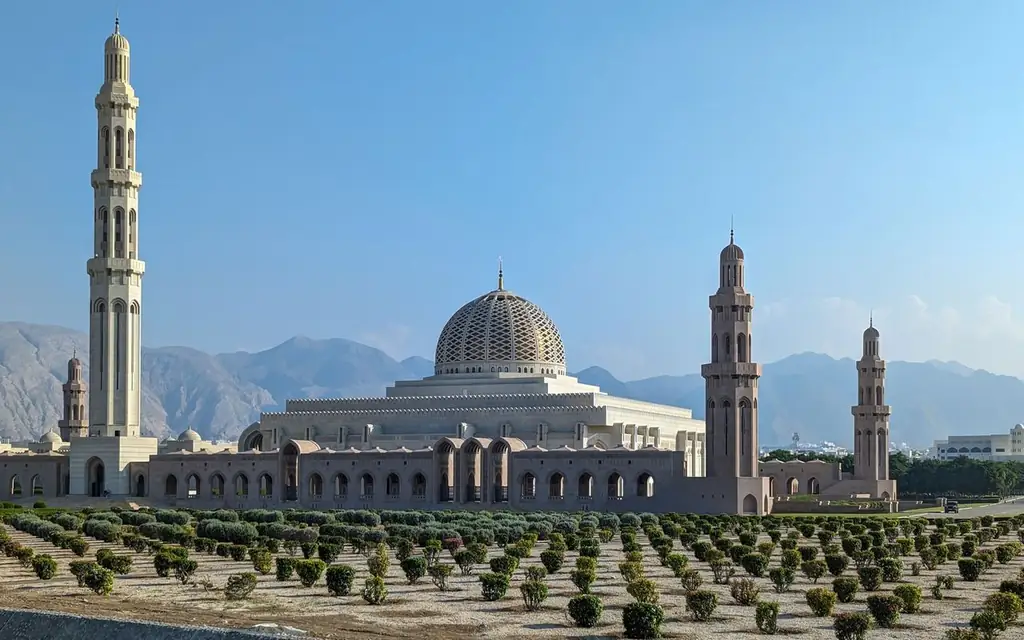
The Sultan Qaboos Grand Mosque opened in 2001. Experience Oman describes it as built from nearly 300,000 tonnes of Indian sandstone, with a dome about 50 metres high, five minarets that represent the five pillars of Islam, and a main prayer hall for about 6,500 worshippers. The total capacity, including the courtyard and other areas, is about 20,000. Other references give the main minaret as about 90 metres high, with four flanking minarets of about 45.5 metres.
Visitors speak most about two features. The first is the prayer-hall carpet, which Experience Oman describes as the world's second-largest hand-woven Persian carpet. The second is the sense of scale and calm inside the hall, with light falling through the dome onto the floor. The grounds are landscaped, with arcades, gardens and courtyards that are worth a walk before you go in.
The mosque is a good counterpart to the Sheikh Zayed Grand Mosque in Abu Dhabi, which is larger and white, whereas the Muscat building is sandstone and more restrained. Many travellers who see one want to compare it with the other, though they are in different countries and best reached by air.
What to wear, and what happens at the entrance
Experience Oman's general guidance asks men to wear long trousers and sleeved shirts or traditional dress, and women to wear loose clothing covering shoulders, chest and knees, with a headscarf required only in mosques. At the Grand Mosque the dress code is strict, because it is an active place of prayer.
- Everyone: clothing that covers shoulders and knees, loose rather than tight, no shorts, no sleeveless tops.
- Women: a headscarf covering the hair. Experience Oman notes that abayas and headscarves are available at the entrance for those who need them, but bringing your own is easier.
- Men: long trousers and a shirt with sleeves. One operator says short sleeves may be allowed for men.
- Shoes: slip-on shoes are best, since you remove them to enter the carpeted hall.
Etiquette matters as much as dress. Keep your voice low, do not walk in front of anyone who is praying, and ask staff before photographing inside. Do not photograph worshippers. Experience Oman asks visitors not to stand in the way of worshippers or block prayer spaces. Alcohol is regulated in Oman and we never promise drinks on board; local law applies.
When to go: the best season and the best morning
Experience Oman recommends December to March as the best time to visit, when the mornings are comfortable. In summer, Muscat is very hot and humid, and even a morning visit means a lot of time outdoors. Arrive at opening to get the shade and the quiet.
Within a week, avoid days when a national event is announced. Arriving at opening gives you the quietest hour in the hall, and the later part of the window tends to be busier with organised groups. If you plan to see a second sight, be on your way out by 10:30.
A chauffeured morning and afternoon in Muscat
Because the mosque closes to visitors at 11:00, it anchors the day and everything else is arranged around it.
- 7:45. Pickup from your hotel. Flight tracking is included for airport pickups.
- 8:15 to 8:30. Arrive at the visitor entrance. Queue early.
- 8:30 to 10:30. Mosque and gardens, at an unhurried pace.
- 10:45. Drive to Muttrah Corniche, about 15 to 25 minutes depending on traffic, for the waterfront and the souq.
- 12:30. Lunch in Old Muscat or at your hotel.
- Afternoon. Rest in the heat, or visit the National Museum in Old Muscat, or Muttrah Fort.
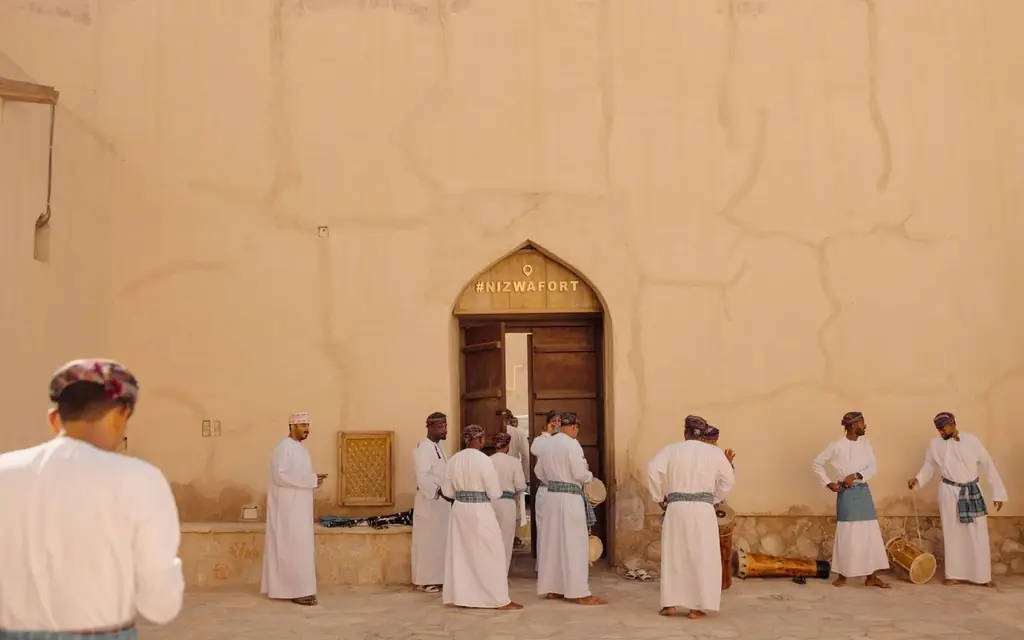
For a longer trip, Nizwa and its fort are the classic inland day from the capital. Our guide to Nizwa Fort explains the drive of about 150 to 170 km (93 to 105 miles) and how to combine it with a Friday market. If you spend two days in Oman, put the mosque on day one and Nizwa on day two. Our page on private tours with a driver shows how we book multi-day hires.
The rest of the morning: Muttrah and Old Muscat
The two best companions are close to the waterfront. Experience Oman lists the National Museum in Old Muscat, opened in 2016 and holding more than 7,000 artefacts, with hours of 10:00 to 17:00 from Saturday to Thursday and 14:00 to 18:00 on Friday. As of 2026 its page gives the foreigner ticket as 5 Omani rials.

Muttrah Fort stands above the old harbour and the Corniche. The Portuguese began it in the 1580s and the Al Ya'arubah rulers rebuilt it between 1624 and 1742, according to Experience Oman, and the listed hours are 8:00 to 23:00 daily, with a non-resident adult ticket of 3 Omani rials as of 2026. The climb is short but sunny, so go late in the afternoon or early evening.
Between those two the Muttrah Corniche and its souq make a flat walk. Allow an hour for the souq if you like bargaining for frankincense, textiles and silver, and take bottled water. A chauffeur can drop you at one end and collect you at the other, so you walk one way only.
Comparing the ways to get there
| Option | From Muscat airport | Cost note | Best for |
|---|---|---|---|
| Metered taxi | About 15 to 30 minutes | Metered or negotiated | Solo travellers, one-way trips |
| Ride-hailing app | About 15 to 30 minutes | Variable, surge possible | Short hops with light bags |
| Organised half-day tour | Fixed schedule | Priced per person | Visitors who want a guide and group |
| Hire car | About 15 to 30 minutes | Rental plus fuel | Confident drivers on Muscat roads |
| Private chauffeur from our desk | About 15 to 30 minutes | Fixed fare via the booker | Arrivals with luggage, families, a timed opening |
A hire car is a sensible choice for confident drivers, though the combination of morning traffic and a tight window makes some visitors prefer to hand over the wheel. A taxi works for a solo traveller. A chauffeur earns its fare on the day you arrive on an overnight flight and want to be at the mosque by opening, or when you travel with elderly relatives, children or luggage.
Ramadan, Eid and other calendar effects
Opening arrangements for visitors can change during Ramadan and around Eid, when worship takes priority and visiting windows may be shortened or suspended. The sources we opened do not publish a Ramadan schedule, so the sensible step is to contact the mosque or your hotel concierge a few days ahead and ask. Plan the rest of the day with an alternative in mind: if the mosque is closed, the Muttrah Corniche and the National Museum make an easy substitute.
Public holidays in Oman also affect traffic. Roads are quiet early in the morning and busy in the late afternoon before long weekends. A driver who plans the pickup around those patterns gives you the best chance of arriving with time to spare.
Families, accessibility and groups
Families with children are welcome, but the dress code applies to everyone and the visit requires patience. A child, toddler or booster seat can be requested at booking. Water and phone chargers are in most vehicles.

The mosque has long walks across polished stone and a shoe-free carpeted hall. If someone in your party has reduced mobility, tell the desk at booking and ask the mosque about assistance at the entrance, since the sources we opened do not describe it in detail. A Luxury SUV is easier to enter and leave than a low sedan.
Groups of seven or more can use an Executive Sprinter, which carries up to 12 to 14 passengers with 12 bags. For delegations, tourism boards and visitor offices, trade accounts with LimousineWorldwideDirectory.com are available. See the tourist offices page.
Booking and what to tell the desk
Enter your hotel or flight as the pickup and Sultan Qaboos Grand Mosque as the destination, and choose a vehicle that fits your party. The Executive Sedan and First Class Sedan carry up to three passengers with two large and two cabin bags, and the Luxury SUV carries up to six. In the Gulf, expect Mercedes-Benz E-Class, S-Class or V-Class vehicles, or similar, with the exact model confirmed at booking.
Put the opening time in the notes, along with your wish to wait while you visit. The booker shows the exact fare for your addresses before you confirm. Chauffeurs do not photograph clients or post about trips, and NDAs and alias bookings are available on request. A chauffeur drives and can suggest stops, but a licensed guide is a separate professional if you want a talk through the architecture.
Frequently asked questions
What time can non-Muslims visit the Sultan Qaboos Grand Mosque?
Experience Oman lists Saturday to Thursday, 8:00 to 11:00 am. Ministry of Tourism guidance gives 8:30 to 11:00 every day except Friday. Check before you travel.
How far is the mosque from Muscat International Airport?
Sources give about 12 to 17 km (7.5 to 10.5 miles) and a drive of around 15 to 30 minutes depending on traffic.
Is there an admission fee?
Experience Oman's page states an admission fee of 8 Omani rials. Older guides describe entry as free, so confirm on the official page before you go.
What should I wear?
Cover shoulders and knees. Women should cover their hair, and abayas and headscarves are available at the entrance. Wear slip-on shoes.
Is the mosque open on Fridays?
Not to non-Muslim visitors, according to the sources we opened.
How long does a visit take?
About one and a half to two hours, including the gardens and the prayer hall.
Can my chauffeur wait while I visit?
Yes. The driver waits nearby and meets you at the agreed point. Parking arrangements vary on busy mornings, so give a realistic finish time.
Can I combine the mosque with Nizwa in one day?
It is possible but tiring, because the mosque closes to visitors at 11:00 and Nizwa is about 150 to 170 km away. Most visitors split the two across separate days.