 United StatesJFK
 MexicoMEX
 BrazilGRU
 ArgentinaEZE
 ChileSCL
 ColombiaBOG
 PeruLIM
 PanamaPTY
 Costa RicaSJO
 Dominican RepublicPUJ
 JamaicaMBJ
 BahamasNAS
 BarbadosBGI
 United KingdomLHR
 IrelandDUB
 FranceCDG
 GermanyFRA
 NetherlandsAMS
 BelgiumBRU
 SwitzerlandZRH
 AustriaVIE
 ItalyFCO
 SpainMAD
 PortugalLIS
 GreeceATH
 TurkeyIST
 DenmarkCPH
 SwedenARN
 NorwayOSL
 FinlandHEL
 PolandWAW
 Czech RepublicPRG
 HungaryBUD
 IcelandKEF
 United Arab EmiratesDXB
 QatarDOH
 Saudi ArabiaRUH
 IsraelTLV
 EgyptCAI
 MoroccoCMN
 South AfricaJNB
 KenyaNBO
 NigeriaLOS
 IndiaDEL
 PakistanLHE
 Sri LankaCMB
 SingaporeSIN
 MalaysiaKUL
 ThailandBKK
 VietnamSGN
 PhilippinesMNL
 IndonesiaCGK
 Hong KongHKG
 ChinaPVG
 TaiwanTPE
 JapanHND
 South KoreaICN
 AustraliaSYD
 New ZealandAKL
Start early, or the steps start without you
The first thing to understand about Batu Caves is the sun. The great Temple Cave sits at the top of 272 steps, in the open, on the side of a limestone outcrop north of Kuala Lumpur. By late morning the stairs are hot, the crowds on them are thicker, and the macaques that live on the hill are bolder. A Batu Caves private tour with driver is built around beating that curve: leave the hotel while the air is still cool, climb first, and spend the heat of the day somewhere indoors.
Our 24/7 booking desk books a vetted, licensed and commercially insured local chauffeur operator from our worldwide directory, so the car, the time and the fare are agreed before you leave. The chauffeur does the part that is easy to get wrong on your own, which is the last kilometre in on a congested road and the meeting point afterwards.
How do you get to Batu Caves by car?
Batu Caves is about 13 km (8 mi) north of central Kuala Lumpur and roughly 70 km (43 mi) from the airport. From KLCC the drive is usually 25 to 45 minutes; from KLIA allow 60 to 90 minutes. Roads around the site are busiest at weekends and festival times.
The route from the city runs north on the main roads toward the Gombak district, then peels off into the narrow streets in front of the complex. Early on a weekday the approach is quick. On Saturdays, Sundays and public holidays, or in the lead-up to a Hindu festival, the final stretch can crawl.
Coming from the airport, the usual plan is to go to your hotel first, leave bags, then do Batu Caves the next morning. If you must go straight from a morning landing, tell the desk when you book, because a luggage-laden climb is not much fun and the car has to wait with your bags. Every airport pickup is flight-tracked, so a late landing does not cost you the car, and the first 60 minutes of waiting after an international arrival are free.
The rest of the region is mapped on the Asia-Pacific directory page, and there is an airports hub for arrival information. You will not find a Kuala Lumpur city page yet; the booking desk handles the city the same way as any other.
What you are climbing to
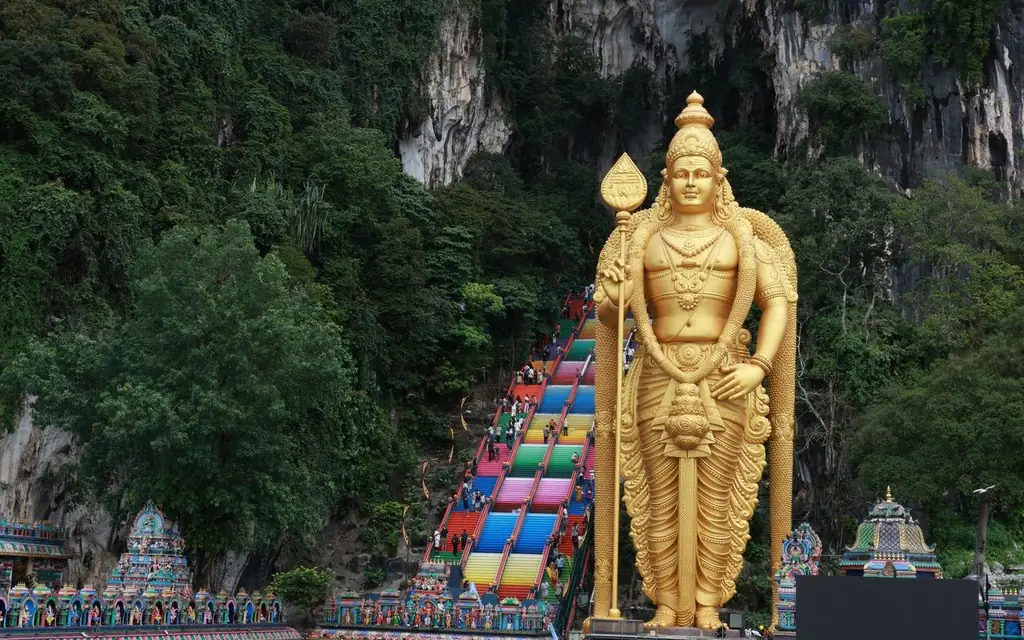
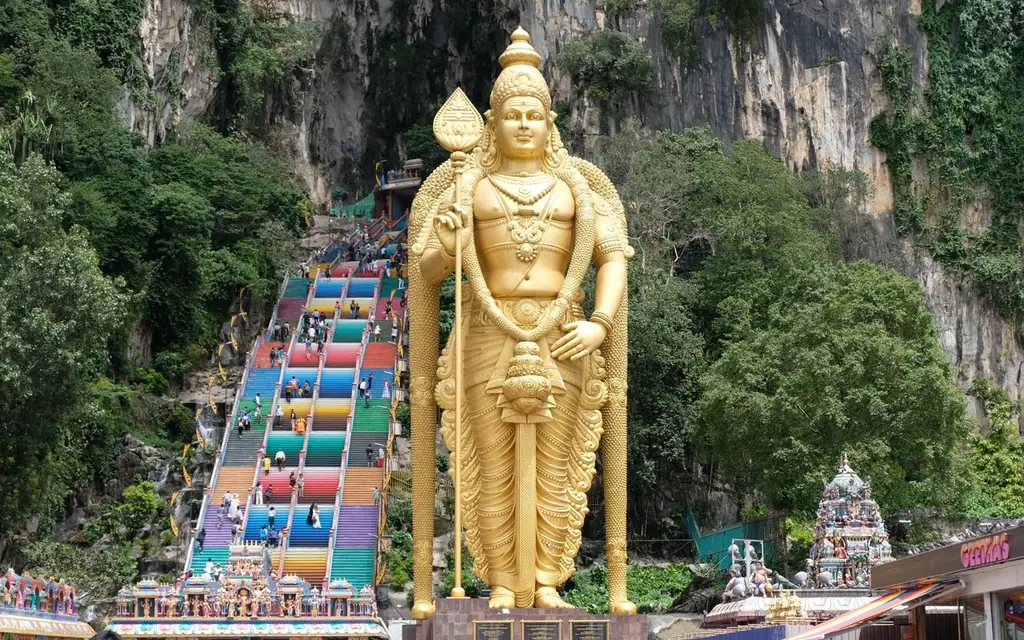
Batu Caves is a Hindu pilgrimage site. The hill holds a cluster of caves, and the temple in the largest of them is dedicated to Lord Murugan. A gold-painted statue of the deity, about 43 m (141 ft) tall, stands at the foot of the staircase and is the first thing you see. The staircase is 272 steps; its handrails and risers have been painted in bright colours, and pilgrims climb it carrying offerings, particularly during festivals.
At the top, the Temple Cave is a vast limestone chamber with a ceiling open to the sky in places, shrines under the rock and a quiet that comes as a surprise after the climb. It is a working place of worship, so keep your voice down and watch where you stand.
Other caves at the base are separate attractions:
- Ramayana Cave. A lower cave with painted scenes from the epic, reached from the left side of the base.
- Art Gallery and Museum caves. More temple art, run separately.
- Dark Cave. A less visited cave system managed for its wildlife; guided visits are arranged separately, and the tours are limited in size.
Each of these has its own hours and small fees, which change. Check on site or with the operator rather than relying on a printed price.
Where the car stops and how the day runs
At Batu Caves the practical problem is not parking but finding the right place to be picked up. The area in front of the staircase is busy with pedestrians, souvenir stalls and tour buses. A chauffeur will drop you as close as the road allows, then wait in a nearby bay or return when you message that you are walking down.
Agree two things with your driver before you climb. First, the exact return meeting point, described by a landmark such as the statue rather than "at the entrance". Second, an approximate time. A typical visit takes 60 to 90 minutes for the climb, the cave, photos and the descent, a little longer if you add the side caves. The 15-minute free waiting window on non-airport pickups is a minimum, not a plan, so the desk can book the car on an hourly basis if you want the driver to stay.
If you would like to see the surroundings before you commit, remember that crowds change the picture fast. A Tuesday morning and a Sunday afternoon are different places.
Dress, monkeys and manners
Modest clothing is expected at the temple: cover your shoulders and knees. Sarongs can be rented near the base for visitors who arrive underdressed, and enforcement is stricter for women than for men in most accounts. Remove shoes where you see signs and shoe racks. Wear footwear you can climb in, since the steps are uneven in places and can be slippery after rain.
The monkeys are long-tailed macaques, and they are used to people carrying food. Do not carry plastic bags with snacks in plain view, do not feed them, and do not make eye contact with a bold animal. Keep sunglasses, phone and water bottle secured. Water is sensible; eating on the steps is not.
Photography is normal, but be considerate of worshippers. If you want an image of someone praying, ask first or leave it. Our chauffeurs do not photograph clients or post about trips, and that discretion applies throughout.
Festival periods: Thaipusam and busy days
Thaipusam, the largest Hindu festival at Batu Caves, is usually held in late January or February, on a date that follows the lunar calendar. For the festival, devotees walk long distances to the site, some carrying kavadi, which are decorated frames, and the grounds fill from before dawn. Roads nearby are closed or restricted, public transport is packed and a car may be diverted well short of the entrance.
If your dates overlap with it:
- Confirm the festival date and any road-closure notice closer to the time.
- Expect the car to stop some distance away and plan to walk.
- Go early or avoid the peak day if you are not there for the ceremony; it is a religious occasion, not a spectacle.
- Be respectful and keep to the edges of processions.
Our desk can quote a normal booking, but festival arrangements can change quickly. Large events may carry a different cancellation deadline, which is stated on the confirmation.
Best time to go
The cooler hours, from soon after the site opens until mid-morning, are best for the climb. Late afternoon is also workable, with softer light, though thunderstorms are common in Kuala Lumpur's wetter months and steps become slick. Weekdays beat weekends. Check opening times for the individual caves, because they differ from the main temple, which is generally open from early morning until the evening.
A rainy-season visit is still possible. The cave itself is sheltered, and a chauffeur can wait at a covered point. What you lose is the view from the top.
Small cautions that save the morning
Treat the base of the staircase as a place where you keep your wits about you rather than your guard up. A few simple habits help:
- Pay only at the official ticket points for the side caves, and ignore anyone offering a guided tour at the foot of the steps for a fee you have not agreed in advance.
- Keep a hand on your bag on the stairs, where people stop suddenly to photograph and the crowd bunches.
- Carry small notes for the rental sarongs and the cave entrances, and decide in advance how much you want to give at the shrines. Donations are voluntary.
- Tell the driver your phone is on. If you are late coming down because of a queue on the stairs, a message lets the car stay where it is rather than circling.
If anyone in your group is unwell in the heat, stop in the shade at the first landing rather than pushing on. The descent is easier than the climb, but it is not shorter on a hot day.
What lies beyond the caves
Most visitors go to Batu Caves, go back to the city and call it done. If you have a longer morning, the Forest Research Institute Malaysia reserve at Kepong lies roughly 10 km (6 mi) to the west and offers shaded forest walks, which suit a family that has had enough of the open stairs. The Gombak area around the caves also has small family-run restaurants serving South Indian food, useful for a late breakfast after an early climb.
For a half day that stays close to the hill, aim to be at the staircase early, finish before the lunchtime peak, and eat nearby before heading back. For a full day, pair the caves with the city's towers and malls in the afternoon, since the drive south is easiest while the commuter rush has not started.
How to reach Batu Caves compared
| Option | Typical time | Cost note | Suits |
|---|---|---|---|
| KTM Komuter train | About 25 to 40 minutes from central stations | Lowest | Solo travellers, flexible timing |
| Metered taxi | 25 to 45 minutes from KLCC | Metered, plus surcharges | A single, direct trip |
| App-based ride-hailing | 25 to 45 minutes from KLCC | Surge-priced at peak and festivals | Short trips with no waiting |
| Hotel or tour coach | Varies | Included or low | Fixed group excursions |
| Private chauffeur | 25 to 45 minutes from KLCC | Fixed fare via the booker | Families, groups, heat-sensitive travellers, a wait at the site |
The Komuter train is a good choice: the Batu Caves station is a short walk from the foot of the steps, and the line is run by the national railway operator, whose timetables are on ktmb.com.my. Check the schedule there before you travel, because service patterns change. A chauffeur is the better choice when you want a door-to-door return, when someone in the group finds the heat or the stairs hard, or when you are combining Batu Caves with the Petronas Twin Towers or a lunch stop on the same morning.
A half-day chauffeured plan
- Early morning. Leave the hotel for the 13 km (8 mi) drive north. Arrive soon after opening.
- First hour. Climb the steps, visit the Temple Cave and come down before the heat peaks.
- Second hour. See one of the side caves if time allows, then rejoin the car.
- Late morning. Return to the city for lunch. Indian vegetarian restaurants around Brickfields, roughly 15 to 18 km (9 to 11 mi) from Batu Caves, are a natural fit after a Hindu temple visit.
- Afternoon. The Petronas Twin Towers with a timed ticket, then KLCC Park. Our guide covers the booking rules.
For a longer Asian itinerary, look at the same kind of heritage visit elsewhere in the region, such as Angkor Wat in Cambodia or Phang Nga Bay from Phuket, and our private tours with a driver page explains hourly and day hire. The attractions hub lists more cities.
Families, mobility and practical points
The 272 steps are the main barrier. They are a real climb and there is no lift or road route to the top that suits visitors with limited mobility, so the Temple Cave is difficult for wheelchair users and for anyone who cannot manage stairs. The lower caves are easier. Ask at booking if anyone in your party needs help, and the desk will confirm the vehicle and the plan.
Children's seats of every size can be requested at booking. Larger parties usually take the Luxury SUV, which fits up to six people and five to six large bags, or an Executive Sprinter for 12 to 14. Kuala Lumpur cars are Mercedes-Benz E-Class, S-Class or V-Class or similar, with the exact vehicle named at confirmation. Bring water and sun protection, and leave valuables in the hotel or the car.
Malaysia lists its Digital Arrival Card among online services on the Immigration Department's website; check whether it applies to your passport. The national tourism board, Tourism Malaysia, publishes general travel information. Trade accounts are open to tourist offices, tourism boards, convention and visitor bureaus and visitor centres that want to book chauffeur services for their visitors with LimousineWorldwideDirectory.com.
Frequently asked questions
How far is Batu Caves from Kuala Lumpur?
About 13 km (8 mi) north of the city centre. Allow 25 to 45 minutes by car, and longer at weekends or during festivals.
How many steps are there at Batu Caves?
272 steps lead up to the Temple Cave. Take water and allow time for rests on the way.
What should I wear to Batu Caves?
Cover your shoulders and knees. Rental sarongs are available near the base for those who need them, and shoes come off where signs say so.
Are the monkeys at Batu Caves dangerous?
They are wild macaques used to being fed. Keep food hidden, do not feed or tease them, and secure loose items such as sunglasses and bottles.
When is Thaipusam at Batu Caves?
It is usually held in late January or February, following the lunar calendar. Confirm the date and road closures nearer the time, and expect restricted access.
Is Batu Caves open every day?
The main temple complex is generally open daily from early morning to evening, but check individual caves and festival notices on the day.
Can a driver wait for me at Batu Caves?
Yes. Hourly or day hire lets the car wait nearby, and the desk confirms a fixed meeting point before you climb. The free waiting window on ordinary pickups is 15 minutes.
Is it better to take the train or a private car?
The KTM Komuter is the lowest-cost option and drops you close to the steps. A private car is better for door-to-door travel, for heat-sensitive passengers and for combining several stops.