
 United StatesJFK
 MexicoMEX
 BrazilGRU
 ArgentinaEZE
 ChileSCL
 ColombiaBOG
 PeruLIM
 PanamaPTY
 Costa RicaSJO
 Dominican RepublicPUJ
 JamaicaMBJ
 BahamasNAS
 BarbadosBGI
 United KingdomLHR
 IrelandDUB
 FranceCDG
 GermanyFRA
 NetherlandsAMS
 BelgiumBRU
 SwitzerlandZRH
 AustriaVIE
 ItalyFCO
 SpainMAD
 PortugalLIS
 GreeceATH
 TurkeyIST
 DenmarkCPH
 SwedenARN
 NorwayOSL
 FinlandHEL
 PolandWAW
 Czech RepublicPRG
 HungaryBUD
 IcelandKEF
 United Arab EmiratesDXB
 QatarDOH
 Saudi ArabiaRUH
 IsraelTLV
 EgyptCAI
 MoroccoCMN
 South AfricaJNB
 KenyaNBO
 NigeriaLOS
 IndiaDEL
 PakistanLHE
 Sri LankaCMB
 SingaporeSIN
 MalaysiaKUL
 ThailandBKK
 VietnamSGN
 PhilippinesMNL
 IndonesiaCGK
 Hong KongHKG
 ChinaPVG
 TaiwanTPE
 JapanHND
 South KoreaICN
 AustraliaSYD
 New ZealandAKL
Girona is the day trip that rewards people who already like Barcelona and want a smaller, older, quieter place at the other end of a motorway. It is 100 km (62 mi) from Barcelona and 65 km (40 mi) from the French border, according to the city's tourism site, which puts it on the natural line between Catalonia's capital and the Costa Brava. A Girona private tour with driver suits travellers who want to leave when they like, avoid timetable arithmetic and add a second stop on the way back.
This page answers the practical questions first: how long the drive takes, whether the train beats a car, and where a car can actually stop. Then it walks the old town in a sensible order, covers the flower festival, and suggests a day plan. The chauffeur is a vetted, licensed and commercially insured local operator from our directory, and the 24/7 desk of LimousineWorldwideDirectory.com handles the booking, the confirmation and the invoice.
Is Girona better by train or by private car from Barcelona?
The high-speed and regional trains are fast and inexpensive, and the station is a short taxi ride from the old town. A private car wins when you are arriving with luggage, travelling as a family or group, or combining Girona with the coast or a second stop. Both take roughly an hour.
The honest comparison depends on how much you are carrying and what you plan to do afterwards. The table sets out the options for a day trip from central Barcelona.
| Option | Typical time | Cost note | Who it suits |
|---|---|---|---|
| Train from Barcelona Sants | About 40 minutes to 1 hour 20 minutes depending on service | Lowest | Solo travellers and couples with light bags |
| Intercity coach | About 1 hour 30 minutes | Low | Flexible travellers without a tight schedule |
| Taxi | About 1 hour 15 minutes | Metered, long-distance | One-way trips |
| Rental car | About 1 hour 15 minutes plus parking | Fuel and car park | Confident drivers who know Spanish roads |
| Private chauffeur | About 1 hour to 1 hour 15 minutes | Fixed fare via the booker | Families, groups, airport arrivals and multi-stop days |
If you are travelling alone and simply want to see the cathedral and walls, take the train. If you are landing at Barcelona–El Prat Airport and heading straight to Girona, the car removes a transfer and a bag-drag. Our Barcelona airport chauffeur page explains the terminals, and from El Prat to Girona the distance is about 100 km (62 mi), usually 1 hour to 1 hour 15 minutes by the motorway network.
The wider Barcelona chauffeur service page explains how the desk sets up city pickups. From a hotel in central Barcelona, the drive is roughly 100 km (62 mi) and 1 to 1.25 hours outside the commuter peaks.
What Girona is, in a paragraph
Girona is a compact city on the Onyar river whose old town climbs a hill above the water. The official tourism site lists its principal sights as the Cathedral, the Jewish Quarter known as the Call, the city walls along the Passeig de la Muralla, the Onyar houses, the Arab Baths and the Romanesque church of Sant Pere de Galligants. Together they make a day that is walkable end to end.
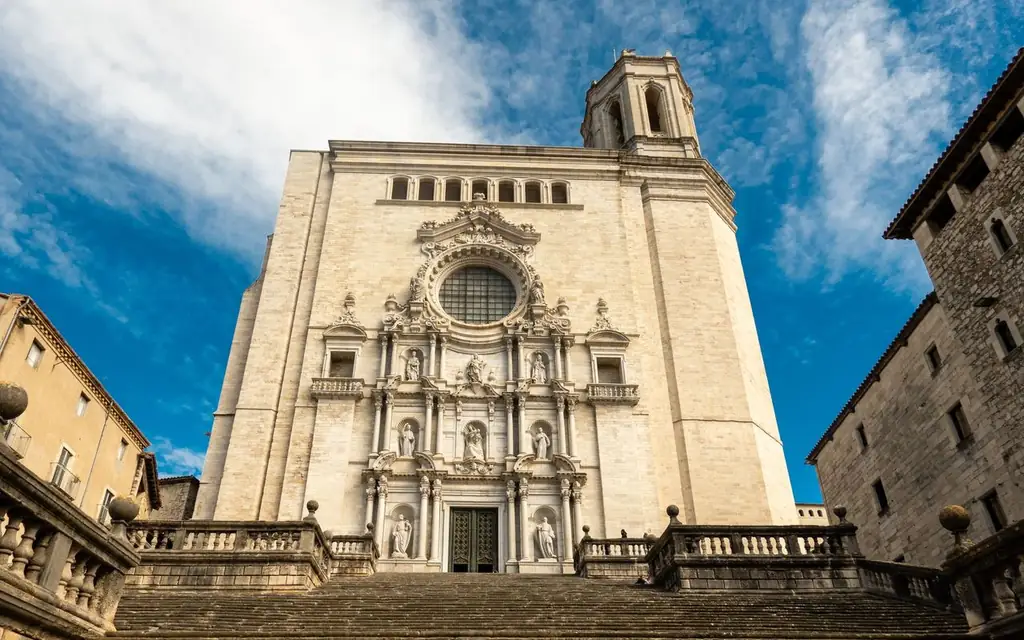
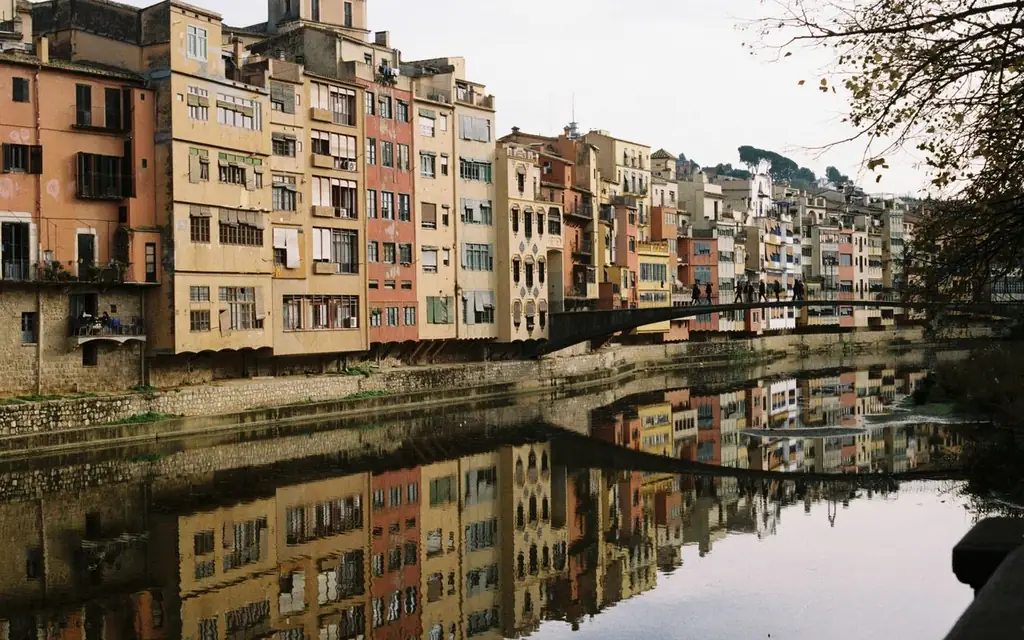
The river frontage is the postcard: tall houses painted in ochres, reds and yellows, lined along the water, and crossed by a series of footbridges. One of them, the iron Pont de les Peixateries Velles, was built by Gustave Eiffel's firm in the nineteenth century. The cathedral looks down on the whole scene from the top of a long baroque staircase, which you will climb on foot.
Where the car stops: traffic zones and car parks
Cars cannot wander through the old town. The city's tourism site notes that car access to the historic centre is restricted, with parking and traffic-zone rules, and it also flags a low-emission zone for the city. For parking, it describes free zones, paid blue zones and privately run car parks, and links an app for the green and blue zones.
In practice, a chauffeur works from the edge of the old town. The most useful pattern is a drop on the Onyar riverfront or the streets on the new-town side, a walk across a footbridge into the old quarter, and a pickup at the same river edge or on the road below the walls. The exact spot depends on the day's traffic and on whether the zone rules allow a stop, so the driver confirms it with you on the morning.
If anyone in your party finds hills or steps hard, say so at booking. The old town is steep in places, and the cathedral stands at the top of a long stair, so the driver may choose a drop that shortens the climb. Booster, toddler and child seats can be added at booking, and most vehicles carry water and chargers.
Visitors who want to understand the rules in detail can read the city's own visitor information on mobility and parking, which describes the free, blue and private options. Local operators on our directory know them, and as a visitor you do nothing.
The old town on foot, in an order that saves your legs
A route that begins low and climbs once is kinder than one that zigzags. Start on the riverside, climb to the cathedral, walk the walls, then descend through the Call.
Onyar river and the footbridges. Begin at the water for the view of the painted houses. Spend ten minutes here, because the light is best in the morning from the new-town side.
Cathedral and the staircase. The cathedral is reached by the long staircase from the square below. Check opening hours and ticketing on the cathedral's own site before you go, because the visit is ticketed and access can change for services.
Passeig de la Muralla. The path along the old city walls gives views over the roofs and the plain. It is a good place to rest for twenty minutes and to understand the geography of the hill.
Sant Pere de Galligants and the Arab Baths. A Romanesque monastery church and a small bathhouse in a medieval style sit close together on the edge of the old quarter. Both can be done in about an hour with a coffee.
The Call. The former Jewish quarter is a maze of narrow, stepped lanes. Slow down here, since the points of interest are details of doorways and stone, and a history museum covers the community's story.
Allow four hours for this route with a coffee and a light lunch. If you want to visit museums, add another hour for each. The order matters because the cathedral stair is the only serious climb: do it when you are fresh, and let the walls and the Call carry you downhill afterwards. Tell the driver which side of the hill you expect to finish on, and the pickup can be placed there.
Temps de Flors: Girona in May
For nine days each spring, the old town fills with flower installations in courtyards, stairways and ruined buildings. The 2026 edition ran from 9 to 17 May, according to the city's announcement, and future editions are usually held in May. In festival week the lanes are crowded, hotels fill and the old-town pavements need patience.

If you plan a visit during the festival, book early and let the desk know your date. Drive times to the edge of the old town do not change much, but parking and drop points are busier, and the car park fills earlier. A weekday morning is calmer than a weekend. Consult the city's official tourism site for the dates of the next edition once they are published.
Girona and the Costa Brava: a second stop that makes sense
Girona is the gateway to the Costa Brava coast, and a car makes it easy to add a second stop. The airport serving the region, Girona–Costa Brava, is about 12 km (7.5 mi) from the city, and a chauffeur can use it for arrivals as well as Barcelona.
From Girona, the town of Figueres, known for its Dalí museum, is about 40 km (25 mi) to the north, roughly 35 to 45 minutes by car. Check the museum's own site for hours and timed tickets before you plan around it. The fishing villages of the coast are 45 to 75 minutes from the city, depending on the road. These are separate days rather than add-ons to a short Girona visit, and the desk can design them as a multi-day driver booking.
If you are returning to Barcelona the same day, resist the urge to add the coast. The old town needs four hours, the drive takes an hour each way, and a tired return in the dark is the weakest part of the day.
A six-hour plan from Barcelona
This schedule fits a morning departure and an evening return, with realistic times.
8:30, pickup in Barcelona. The motorway is lighter before 9:00. A Barcelona hotel or the Gothic Quarter edge are common starting points.
9:45, arrival at the river. The driver drops you at the river edge.
10:00 to 12:30, the old town. Cathedral, walls and the Call, in the order above.
12:30 to 14:00, lunch. Eat in the old town; many places offer a fixed lunch menu.
14:00, pickup. Your driver collects you at the agreed point.
15:15, back in Barcelona. Continue to a dinner booking or a visit such as Casa Batlló in the evening.
For a longer trip, the mountain monastery of Montserrat is on a different road out of Barcelona, so do it on another day. Our private tours with a driver page explains how a chauffeur for the day works, and the Europe directory lists the other cities where the desk operates.
Practical details before you leave Barcelona
Wear shoes with grip, because the stone steps of the Call and the cathedral stair are worn smooth. Carry water and a light layer, as the hill catches wind in the cooler months. Leave larger bags in the car or at the hotel; the driver can hold luggage in the vehicle while you walk, which is a real advantage over the train when you have a suitcase from the airport.
The city offers a visitor card for its museums and monuments, according to the tourism site, and the tourist office at Plaça del Vi 1 can explain what it covers. Tourist offices and visitor bureaus can book chauffeur services for their visitors with LimousineWorldwideDirectory.com through a trade account, which is useful for groups arriving from a hotel or a conference.
Flight tracking is included on airport pickups, with 60 minutes of free waiting after an international landing and 30 minutes on a domestic one. On other pickups, such as a Barcelona hotel, the free waiting time is 15 minutes, so be at the door when the driver messages you.
When to go and what to avoid
Spring and early autumn give the best light and the most comfortable walking. Summer is hot in the stone lanes, with afternoons best spent in shade, and winter is quiet but short on daylight. If you want the river at its best, early morning is the time.
Weekends are busier than weekdays, and festival week is busier than any other. The first week of the school summer holidays and the long public-holiday weekends push traffic on the motorway toward the coast, so leave early or late. The city's tourism office, at Plaça del Vi 1, can help with local events on the day.
Frequently asked questions
How far is Girona from Barcelona by car?
About 100 km (62 mi), and usually 1 hour to 1 hour 15 minutes outside rush hour. The fare is fixed and quoted in the booker for your exact pickup, so there is no surprise on the day.
Can a car drive into Girona's old town?
Not freely. Car access to the historic centre is restricted, with parking and traffic-zone rules, so a chauffeur drops you at the edge and you walk in.
How long do I need in Girona?
Allow four hours for the old town with a coffee and lunch, and add an hour for each museum. A day trip from Barcelona is about six to seven hours door to door.
Is the train better than a private car for Girona?
For a solo traveller with light bags, the train is the better value. A private car suits families, groups, airport arrivals and anyone who wants a second stop on the way.
When is the Girona flower festival?
The 2026 edition ran from 9 to 17 May. Future editions are usually held in May, so check the city's tourism site for the next dates.
Can I fly into Girona instead of Barcelona?
Girona–Costa Brava Airport is about 12 km (7.5 mi) from the city. Many international visitors use Barcelona–El Prat, about 100 km (62 mi) away, because of its wider range of flights.
Is Girona suitable for people with limited mobility?
The old town is steep and the cathedral is reached by a long staircase. Tell us at booking, and the driver will choose the closest practical drop and a flatter route.
Do I need a licensed guide in Girona?
None is required to walk the old town. A licensed guide adds depth on the cathedral, the Call and the walls, and is a separate professional from the chauffeur, who drives and can suggest stops.