
 United StatesJFK
 MexicoMEX
 BrazilGRU
 ArgentinaEZE
 ChileSCL
 ColombiaBOG
 PeruLIM
 PanamaPTY
 Costa RicaSJO
 Dominican RepublicPUJ
 JamaicaMBJ
 BahamasNAS
 BarbadosBGI
 United KingdomLHR
 IrelandDUB
 FranceCDG
 GermanyFRA
 NetherlandsAMS
 BelgiumBRU
 SwitzerlandZRH
 AustriaVIE
 ItalyFCO
 SpainMAD
 PortugalLIS
 GreeceATH
 TurkeyIST
 DenmarkCPH
 SwedenARN
 NorwayOSL
 FinlandHEL
 PolandWAW
 Czech RepublicPRG
 HungaryBUD
 IcelandKEF
 United Arab EmiratesDXB
 QatarDOH
 Saudi ArabiaRUH
 IsraelTLV
 EgyptCAI
 MoroccoCMN
 South AfricaJNB
 KenyaNBO
 NigeriaLOS
 IndiaDEL
 PakistanLHE
 Sri LankaCMB
 SingaporeSIN
 MalaysiaKUL
 ThailandBKK
 VietnamSGN
 PhilippinesMNL
 IndonesiaCGK
 Hong KongHKG
 ChinaPVG
 TaiwanTPE
 JapanHND
 South KoreaICN
 AustraliaSYD
 New ZealandAKL
Lima rewards a visitor who builds the day around the clock. The historic centre has one fixed appointment, the changing of the guard at the Government Palace at about noon, and everything else can be arranged before or after it. Morning traffic from the airport and the districts of Miraflores and San Isidro is the part that cannot be arranged, which is where a driver who knows the cut-throughs earns the booking.
A Lima historic centre private tour with driver is a short, tightly timed trip: a morning for the Plaza Mayor, the Cathedral and the San Francisco convent, with the car holding the lines between them. This guide covers the airport run, how to time the plaza, what the car can and cannot do in the pedestrian streets and how the district fits into a longer trip to Cusco and Machu Picchu.
What makes the Lima historic centre worth a morning?
The Historic Centre of Lima is a UNESCO World Heritage district. The San Francisco convent ensemble was listed in 1988, and in 1991 the listing widened to parts of the colonial town on both sides of the Rimac. It records a Spanish colonial capital of major importance in Latin America.
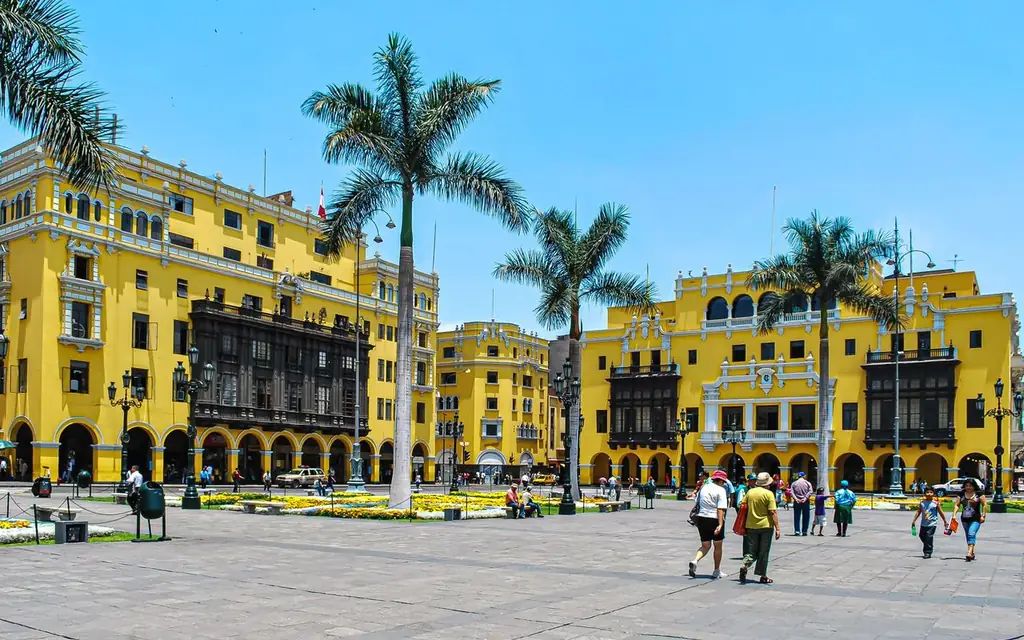
UNESCO lists the property at about 278 hectares, with a larger buffer zone around it. In practical terms, the part a visitor sees is a compact grid around the Plaza Mayor, with the Cathedral, the Government Palace, the Archbishop's Palace and the Municipal Palace on or beside the square. The convent of San Francisco is about 350 m from the plaza, close enough to walk. Everything is within a short loop on foot, and the district rewards a morning rather than a day.
From the airport: 11 km that can take 35 minutes or 90
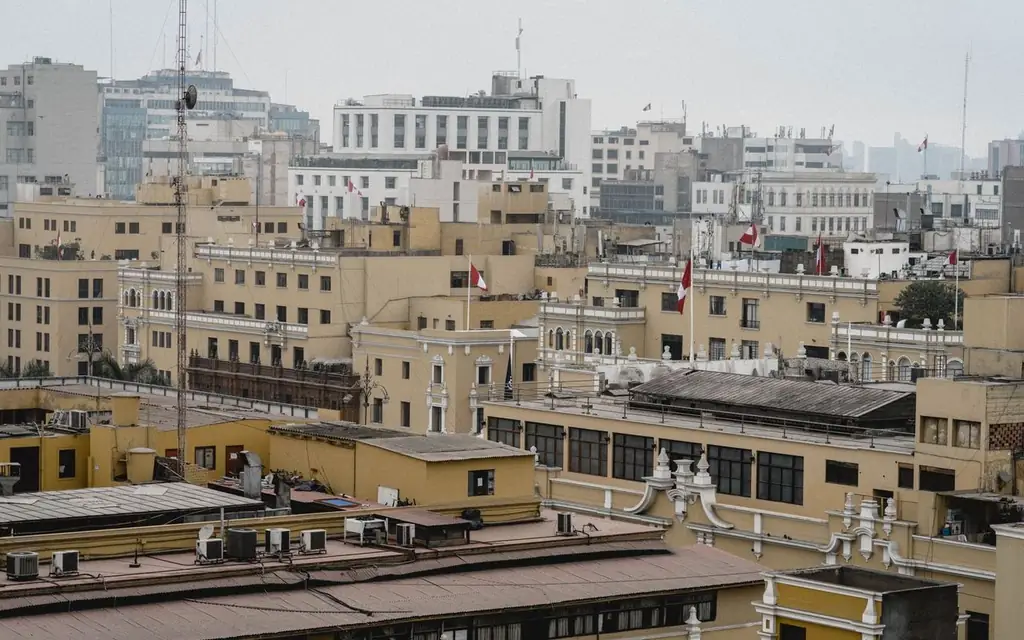
Jorge Chávez International Airport lies in Callao, about 11 to 12 km (7 mi) from the historic centre. In light traffic the transfer takes about 35 to 40 minutes. At peak hours, and especially in the evening, the same distance can take well over an hour, because the arterial roads between Callao and the center carry heavy commuter and truck traffic. The airport's operator reports that its new passenger terminal has been in operation for about a year as of October 2026, so check your airline's terminal and the pickup arrangements on the day.
A pre-booked chauffeur sets the fare before you travel and tracks your flight, so a delayed arrival does not leave you without a ride. For a first visit, ask the desk to schedule the airport pickup around a rest period, not straight into sightseeing, if you are coming off an overnight flight. Lima sits near sea level, so there is no altitude issue here, but the transition to Cusco at 3,399 m is the one to plan for.
The noon ceremony at the Government Palace
The changing of the guard takes place in front of the Government Palace on the Plaza Mayor at around noon, and visitors who want a front-row position arrive by about 11:45. It is free to watch, and the guided interior tours of the palace are free but need to be booked in advance, with some sources advising at least two days. Access can be restricted for security reasons, and the interior tours may not run on every day.
Plan the morning backward from noon. A route that finishes at the plaza as the ceremony begins avoids the crowd that forms an hour earlier. The ceremony itself is brief and public, and the plaza is closed to vehicles in the area around the palace, so the car waits on a nearby street.
A timed morning route
| Time | Stop | Notes |
|---|---|---|
| 09:00 | Pickup in Miraflores or San Isidro | 12 to 15 km (7 to 9 mi) to the center, 30 to 60 minutes |
| 09:45 | San Francisco convent and catacombs | About 350 m from the Plaza Mayor |
| 11:00 | Walk to the Plaza Mayor | Cathedral, Archbishop's Palace, Municipal Palace |
| 11:45 | Position for the guard ceremony | Arrive early for a front-row view |
| 12:30 | Lunch near the plaza | Chauffeur collects at a nearby street |
| 14:00 | Drive on to Pueblo Libre, Miraflores or Barranco | Optional extension, 8 to 15 km (5 to 9 mi) |
Times shift with traffic, and the schedule is a guide, not a promise. Ask the desk to adjust the pickup if you plan to include a museum outside the center.
The San Francisco convent and its catacombs
The San Francisco convent is a colonial complex with a church, a library and the catacombs below. UNESCO's first Lima listing in 1988 was for this ensemble, and the catacombs are the best-known feature for visitors. Sources disagree on the opening hours, with some listing a closing time of 5 p.m. and others 6 p.m., so check the convent's current schedule before you plan the route. Visit with a guide if you can, since the catacombs are an unlabeled maze without one.

The convent is close enough to the plaza to walk, about 350 m (0.2 mi), so a chauffeur is most useful for the drop-off and the pickup, not the connection. Ask the driver to wait on the street nearest the convent entrance.
Where the car can and cannot stop
The Plaza Mayor and some streets around it are restricted to pedestrians or to official vehicles, particularly on ceremony days and at the palace. A car will stop on the perimeter, and the final approach is a short walk. Several of the central streets are one-way, and delivery vehicles and buses crowd the narrow lanes in the morning, so a drop-off one block away is common practice. On days with a march, a procession or a political event, police may close the square and the streets around it at short notice, and the driver will move to the nearest open street.
Parking in the centre is limited. A chauffeur who waits with the car solves that problem, and the alternative is a taxi hailed on the street, which may be hard to find at the plaza on ceremony days.
Staying comfortable and secure in the center
The historic centre is busy, and as in any large city it rewards sensible habits. Keep phones and bags close, carry a copy of your passport instead of the original, and avoid displaying jewelry. After dark the center empties of daytime crowds, and a car with a waiting driver is a better choice than a long walk. A chauffeur is a driver, not a security service, and we do not provide armed drivers or bodyguards. For clients who travel with their own security team, the vehicle and driver work alongside that team.
Dress for a mild, often overcast day. Lima's winter, roughly June to November, brings low gray cloud that can hide the sun for weeks, while summer from December to March is warm and humid. The cloud rarely brings heavy rain, but it makes the center feel cooler than the thermometer suggests.
Extending the trip beyond the center
From the center, Miraflores and Barranco are the common next stops, about 12 km (7 mi) south along the coast and 25 to 45 minutes away depending on traffic. Visitors who have one day in Lima often pair a morning in the historic centre with an afternoon on the coast. Those who have a flight to Cusco the next morning should keep the evening free.
For the Andes, the guide to the Cusco historic centre explains the altitude, and the page on reaching Machu Picchu by car covers the rail and bus handover. If you are building a longer Peru trip, the private tours with driver page explains how multi-day bookings with a single desk work.
Returning to the airport without a scramble
The reverse run needs more margin than the arrival. Between the afternoon rush and the roads around Callao, a departure that looks comfortable on paper can become a race. For an international flight, leave the hotel with time to spare for the drive of 11 to 12 km (7 mi) plus check-in, and for a domestic flight to Cusco, which takes roughly an hour and a half in the air, allow a slightly shorter but still generous margin. The desk can schedule the pickup backward from your flight, and a driver who monitors traffic on the day will move the departure earlier if the roads deteriorate.
If your itinerary has a tight connection, ask the desk to arrange the pickup at the hotel entrance with luggage loaded, and avoid a final sightseeing stop on the way. A morning in the center followed by an afternoon flight is workable only if the plaza visit ends by early afternoon.
When Lima is a stopover, not a destination
Many visitors treat Lima as the staging city for the Andes. A sensible stopover pairs one morning in the historic centre with one afternoon on the coast, then an early flight to Cusco, since a morning arrival gives you the whole day to adapt at altitude. The Sacred Valley of the Incas is lower than Cusco and is the standard first night for anyone sensitive to altitude, so a chauffeur transfer from the Cusco airport directly down the valley fits the pattern.
Visitors who enjoy colonial districts will find the same layered history in other Latin American cities. Cartagena's walled city in Colombia and Antigua Guatemala are both covered in the directory, and each has its own approach for cars, so the practical advice here does not transfer. Read each guide for the local drop-off reality.
Lunch near the plaza works best when it is booked ahead. Restaurants in the centre can fill on weekdays, when office workers and visitors arrive at the same hour, and a reservation keeps the schedule intact after the guard ceremony. Tell the desk the restaurant's street, not only its name, so the driver can wait at the nearest open corner. If you would rather eat later on the coast, skip the lunch stop and let the car carry you on to Miraflores or Barranco.
Dressing, timing and small practicalities
The center is a place for comfortable shoes and a light jacket. Churches expect covered shoulders, so carry a scarf or a light layer. Carry small bills for entry fees and tips, and keep passports in the hotel safe where possible. Opening hours for churches, museums and the convent change by day and by season, and some sites close on specific weekdays, so check the current schedule on the site's own channels before you fix a time. A chauffeur will adapt the route if one stop turns out to be closed, which is another reason to keep the morning loose around the noon appointment.
How to compare ways of seeing the center
| Choice | Upside | Downside |
|---|---|---|
| Metropolitano bus rapid transit | Lowest cost, crosses the center | Crowded at peak, stops are not at the sites |
| Taxi or ride-hailing app | Flexible | Fares vary and pickup points are limited near the plaza |
| Walking tour | Includes a guide | Fixed route and pace |
| Private chauffeur with a car | Door-to-door, waits, fare quoted before you book | Cannot enter pedestrian streets |
The Metropolitano is a good choice for a solo traveler with time and no luggage. A chauffeur is better with a flight to catch, luggage in the car or a group that wants to stay together.
Booking and what the desk needs
Send the desk your arrival flight, your hotel and whether you want the morning route or a return run to the airport. Booking is handled by LimousineWorldwideDirectory.com from Toronto, 24 hours a day, while a vetted, licensed and commercially insured operator in Lima drives. In arrivals, a name board can be arranged as an add-on, with an alias if you wish. More destinations are gathered on the regional page, and the airports hub lists the arrival airports we cover. Tourist offices may book through a trade account.
Reliable references: the UNESCO record for the Historic Centre of Lima, the Lima airport operator for terminal information and the national tourism board Peru Travel.
Frequently asked questions
How far is Lima airport from the historic centre?
About 11 to 12 km (7 mi). The drive takes 35 to 40 minutes in light traffic and can take more than an hour at peak times.
When is the changing of the guard in Lima?
Around noon at the Government Palace on the Plaza Mayor. Arrive by about 11:45 for a front-row position. It is free to watch.
Can I tour the Government Palace?
Guided interior tours are free but must be booked in advance, with some sources advising at least two days. Access can be restricted.
Can a car drive into the Plaza Mayor?
The area around the palace is closed to general traffic. A car stops on a nearby street and you walk the last block.
How long should I allow for the historic centre?
A morning of three to four hours covers the convent, the plaza and the Cathedral. Add a lunch stop and an extension to Miraflores or Barranco for a full day.
What is the best time of year to visit Lima?
Summer, December to March, is warm and sunny. From about June to November the sky is often gray, but the center remains open and pleasant for walking.
Is the historic centre safe for visitors?
The center is crowded by day, so use ordinary urban care: keep valuables out of sight and take a car in the evening. A chauffeur is a driver, not a bodyguard.
Should I hire a guide for the catacombs?
A guide makes the catacombs far easier to follow and is arranged separately. Your driver can wait on the street outside the convent.