 United StatesJFK
 MexicoMEX
 BrazilGRU
 ArgentinaEZE
 ChileSCL
 ColombiaBOG
 PeruLIM
 PanamaPTY
 Costa RicaSJO
 Dominican RepublicPUJ
 JamaicaMBJ
 BahamasNAS
 BarbadosBGI
 United KingdomLHR
 IrelandDUB
 FranceCDG
 GermanyFRA
 NetherlandsAMS
 BelgiumBRU
 SwitzerlandZRH
 AustriaVIE
 ItalyFCO
 SpainMAD
 PortugalLIS
 GreeceATH
 TurkeyIST
 DenmarkCPH
 SwedenARN
 NorwayOSL
 FinlandHEL
 PolandWAW
 Czech RepublicPRG
 HungaryBUD
 IcelandKEF
 United Arab EmiratesDXB
 QatarDOH
 Saudi ArabiaRUH
 IsraelTLV
 EgyptCAI
 MoroccoCMN
 South AfricaJNB
 KenyaNBO
 NigeriaLOS
 IndiaDEL
 PakistanLHE
 Sri LankaCMB
 SingaporeSIN
 MalaysiaKUL
 ThailandBKK
 VietnamSGN
 PhilippinesMNL
 IndonesiaCGK
 Hong KongHKG
 ChinaPVG
 TaiwanTPE
 JapanHND
 South KoreaICN
 AustraliaSYD
 New ZealandAKL
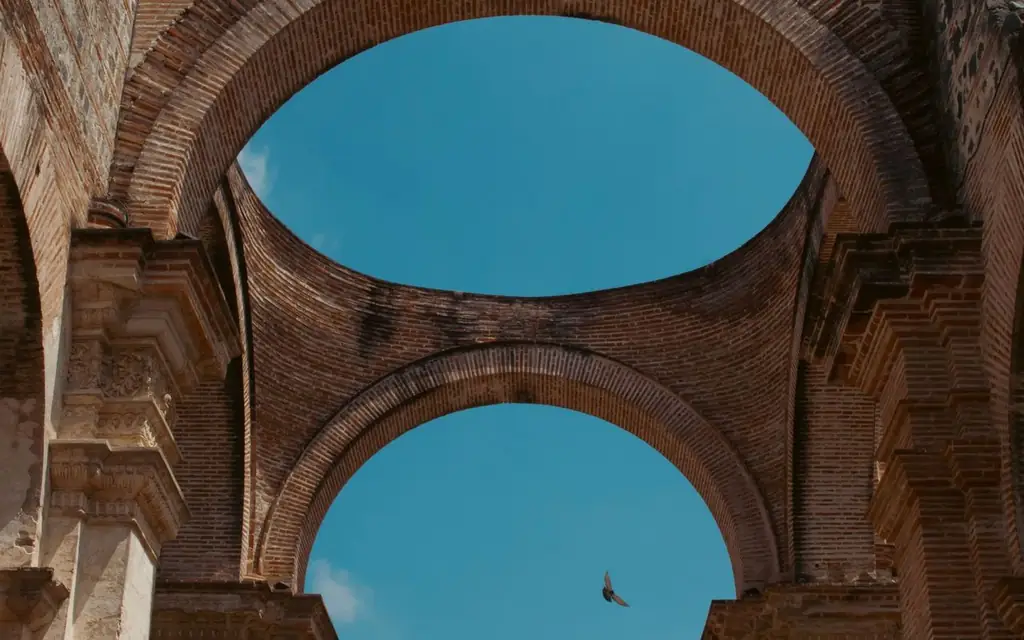
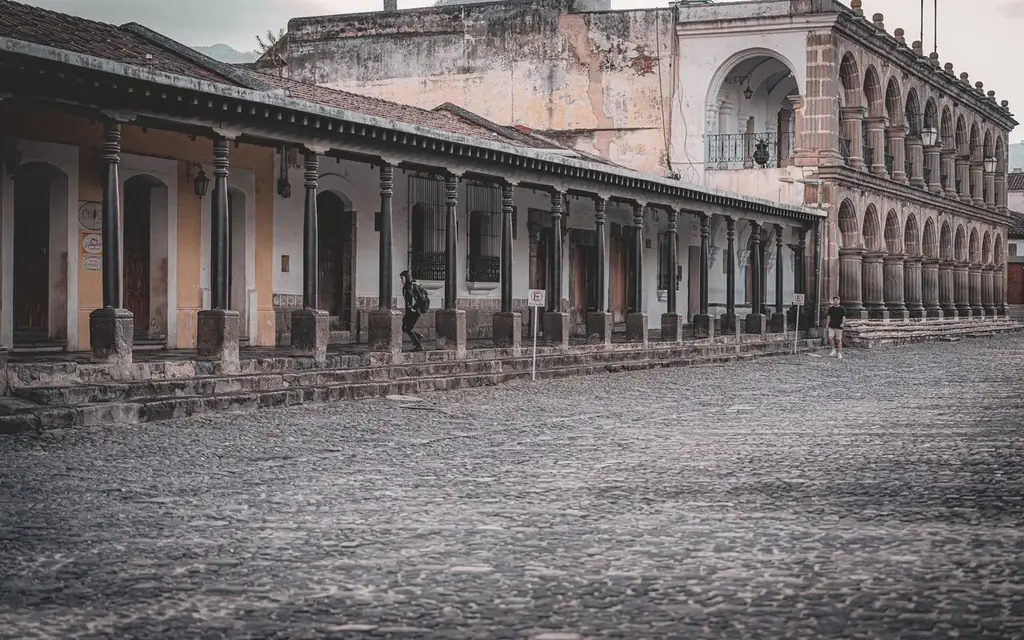
Antigua Guatemala has been a ruin and a revival at the same time for two and a half centuries. It was the seat of Spanish colonial government for the region until earthquakes in 1773 made the authorities move the capital to the present Guatemala City, and the abandoned churches and convents were left standing as shells. Today the grid of cobbled streets, the colored façades and the three volcanoes on the horizon make it one of the most photographed towns in Central America.
If you are searching for an Antigua Guatemala private tour with driver, the story that matters is logistics. The town lies west of Guatemala City, the road in can be slow, the historic center has traffic and parking rules that limit where a car can stop, and Holy Week closes the core to vehicles altogether. This guide explains how to plan the drive from La Aurora airport, how the grid works for a car, what a walking loop looks like and when the volcano trips fit.
Why is Antigua Guatemala a World Heritage city?
UNESCO lists Antigua Guatemala for its Spanish colonial grid, churches and convents, many of them ruined by the earthquakes of 1773, after which the capital was moved. The town sits in a valley ringed by volcanoes, and its streets are cobbled and low-rise.
The visitor-facing result is a compact town that can be seen on foot: a central square, Parque Central, with the cathedral ruins beside it, the Santa Catalina Arch a few blocks north, and churches and convents on almost every corner. Volcán de Agua is the cone to the south, while Fuego and Acatenango lie to the southwest, and Fuego is an active volcano that sends up periodic plumes.
From La Aurora airport: 40 to 47 km and the traffic clock
La Aurora International Airport in Guatemala City is about 40 to 47 km (25 to 29 mi) from Antigua, depending on the route. Outside the commuter peaks, the drive takes roughly an hour. Morning and evening peaks, typically 8 a.m. to 10 a.m. and 5 p.m. to 7 p.m., can stretch the drive to well over two hours, and on a bad day to three. The congestion is on the exits from the capital and the climb to San Lucas Sacatepéquez, and an accident on the single-carriageway sections can hold the road for an hour.
This is the reason to book the transfer, not hail a taxi, and to plan the flight around the road. A late-morning arrival avoids the worst of the morning rush, and an early-afternoon departure from Antigua avoids the evening one. Flight tracking on the pickup means that a delay does not leave the driver waiting at the wrong time. For a departure, build in a margin of at least three hours between the hotel and the airport check-in.
The routes in
The usual route leaves the capital on the western highway through Mixco and San Lucas Sacatepéquez and descends into the Antigua valley, while an alternative runs through Santa Lucía Milpas Altas. The driver chooses between them on the day depending on accidents and congestion, which is a decision that benefits from local knowledge and a live view of traffic. Mountain mist can reduce visibility on the descent in the rainy season, and slow-moving trucks are common.
Tell the desk the name of your hotel in Antigua, because the last kilometer depends on it. Many of the boutique hotels are in converted colonial houses inside the grid, with doorways on narrow streets.
Late arrivals and night driving
Many international flights land in Guatemala City in the evening, and the road to Antigua after dark has fewer vehicles but more hazards: slow trucks, unlit sections and fog on the descent. The sensible choices are to sleep in the capital near the airport and drive in the morning, or to use an experienced driver who knows the road and has been told your landing time. Ask the desk to match the pickup to your arrival and to confirm the hotel's check-in procedure for late guests, since small colonial hotels often lock the front door at night. We do not recommend a self-drive rental on a first night after a long flight.
Inside the grid: where a car can and cannot stop
The historic center has a rule set that limits vehicles. A transfer operator notes that drivers drop guests near the central park, where vehicle access is restricted. Parking is regulated in the municipality with daily street fees, according to a 2022 municipal reform reported in the local press, and curb colors are used to mark where stopping is allowed. Red lines mean no parking. Because the details change, treat these as signals to check with your hotel, not as rules to rely on.
In practice, a chauffeur will take you to the hotel entrance if the street allows, or to the nearest permitted point, and the hotel will take the bags over the cobbles. Cobblestones are hard on wheeled suitcases, so pack a soft bag where you can. During processions and festivals, the municipality closes streets with little notice, and the driver will use the edge of town.
Parking, fines and the municipal notices
The municipality of Antigua publishes parking and traffic information on its own site, which links a map of available car parks and a page for traffic fines. That is the place to check if you have a hired car or a driver who plans to wait, since the rules differ by street and change with events. For most visitors the simpler path is to let the chauffeur handle the car and be collected at a street corner you have both agreed on. A driver who waits in a restricted spot risks a fine and a move-on order, so a pickup by message is better than a fixed waiting time.
A walking loop through the colonial center
Antigua is a walking town. A good loop starts at Parque Central, with the cathedral ruins beside it, then goes north along the main avenue to the Santa Catalina Arch, which was built so that nuns could cross between two buildings without being seen and is now the symbol of the city. From there, go on to the church of La Merced and the nearby convents, and finish with a climb to Cerro de la Cruz, a hill viewpoint north of town that is a 15 to 30 minute walk uphill from the central plaza and has no entry fee. The hill gives the classic view over the town toward Volcán de Agua.
Allow half a day for the loop with museum or church stops. Opening hours vary and many sites close for religious services, so check each one. A chauffeur can drop you at the arch or the hill, and collect you at the end instead of making you retrace the route.
Antigua Guatemala private tour with driver during Holy Week
Semana Santa is the most important week in Antigua. Between Palm Sunday and Easter Sunday the town hosts daily processions on the cobbled streets, and residents lay out detailed carpets of colored sawdust and flowers (alfombras) along the routes. In 2027 Palm Sunday falls on March 21 and Easter Sunday on March 28, which is early in the year and in the dry season.

Vehicle access in the center is banned in Holy Week, according to reports on the last few years. Entry roads back up, and the town becomes a pedestrian zone, so the approach from Guatemala City can take far longer than usual. If you plan to be in Antigua that week, book accommodation and a driver as far ahead as you can, expect to be dropped at the edge of town and plan to walk. The municipality publishes the official procession routes, which change each year, so rely on those, not on a printed guide.
Volcano day: Pacaya and the views
Pacaya is the most popular volcano excursion, with guided hikes and a drive of roughly an hour to 75 minutes each way from Antigua, a distance estimated at 25 to 50 km (16 to 31 mi) depending on the route and trailhead. There is no public transport to the trailhead, so tours are the norm, and hiking requires a local guide. A chauffeur can take you to the trailhead and wait, or collect you at the end.
Acatenango is a harder overnight climb, and Fuego is active, so check the official guidance on alerts before any trip. The national tourist assistance line, ASISTUR, operates around the clock at 1500 according to the Guatemalan tourism institute INGUAT. Volcano trips depend on weather and activity, and the driver can move the schedule by a day if conditions are poor.
Coffee estates, markets and slower days
The slopes around Antigua are coffee country, and several estates offer visits that fit a half day with a driver. Hours and booking rules are set by each estate, so reserve ahead and tell the desk the address. The town's markets and workshops are a separate pleasure: craft stalls, textiles and jade shops cluster near the center, and a morning at a market is easier with a driver for the purchases you do not want to carry. The altitude of about 1,500 m is easy for most visitors, so there is little need to acclimatize, but evenings are cool.
Dress, respect and photography at churches
Many of the ruins are open-air sites and the working churches are active places of worship. Dress modestly for a church interior, remove hats, speak quietly when services are running and respect any photography signs. During Holy Week, processions are acts of devotion as well as spectacles, so keep to the edges, do not step onto the carpets and let bearers pass. A tripod in a crowded street is a nuisance, and a driver cannot hold a place for you, so travel light and be patient.
When to go
The dry season, roughly November to April, has clearer skies and cooler nights at the town's altitude of about 1,500 m. The rainy season, roughly May to October, brings afternoon storms, and they matter for the road and for the volcano hikes. Mornings are usually the clearest, and the volcanoes are often hidden by midday in the wet months. Pack a light jacket for evenings, because the valley cools quickly.
Comparing ways to get to Antigua
| Option | Time from La Aurora | Cost note | Suits |
|---|---|---|---|
| Private chauffeur | About 1 hour off-peak, up to 3 at peak | Fixed fare quoted before booking | Luggage, children, tight departures |
| Shared shuttle | 45 to 75 minutes plus stops | Lowest per person | Solo travelers with flexible timing |
| Taxi from the airport | Similar | Negotiated | Short notice |
Shuttles are frequent and cheap, but they leave on a schedule and stop at several hotels. A chauffeur is better with luggage, a young family or a tight departure time.
Pairing Antigua with other destinations
Antigua is a good base for a quiet first stay in Guatemala before a flight onward. Visitors who like colonial towns will find a similar scale in San Miguel de Allende in Mexico and in Cartagena's walled city in Colombia, each with its own approach for cars. For a volcano of a different kind, the guide to Arenal Volcano in Costa Rica covers a landscape that can be seen from a vehicle.
Booking runs through the around-the-clock desk of LimousineWorldwideDirectory.com in Toronto. The vehicle and chauffeur come from a vetted, licensed and commercially insured operator in Guatemala listed in our directory, and you deal only with us for the confirmation and the invoice. For an Antigua pickup, give the desk your flight number and the name of the hotel: the driver tracks the flight, and a name board in arrivals can be added, with an alias if you prefer privacy. Seats for children are arranged when you book. The private tours with driver page covers multi-stop days, other destinations are grouped under the Latin America and Caribbean region, and the airports index shows the airports we cover. Tourist boards and travel-trade clients can ask the desk about a trade account.
For official information, see the Guatemalan tourism institute INGUAT, the municipality of Antigua and UNESCO's record for Antigua Guatemala.
Frequently asked questions
How far is Antigua from Guatemala City airport?
About 40 to 47 km (25 to 29 mi). The drive takes around an hour off-peak and can take two to three hours at the commuter peaks.
Can a car drive into the center of Antigua?
Access near the central park is restricted, and parking is regulated. A chauffeur drops you at the hotel or the nearest permitted point.
What is the best time to travel from the airport?
Late morning or early afternoon avoids the commuter peaks, which are typically 8 to 10 a.m. and 5 to 7 p.m.
When is Holy Week in 2027?
Palm Sunday is March 21 and Easter Sunday is March 28, 2027. Vehicles are banned in the center during the week, so plan to walk.
How far is Pacaya volcano from Antigua?
Estimates range from about 25 to 50 km (16 to 31 mi) by road, a drive of 60 to 75 minutes. A local guide is required for the hike.
Is Antigua safe for visitors?
It is a popular, tourist-oriented town, and normal precautions apply. INGUAT lists a free 24-hour tourist assistance line, ASISTUR 1500.
How long should I spend in Antigua?
A day covers the main loop, and two or three days allow a volcano trip and a slower pace.
Do I need a guide for the volcano hike?
Yes. Pacaya is walked with a local guide. The driver takes you to the trailhead and waits or returns for you at an agreed time.