 United StatesJFK
 MexicoMEX
 BrazilGRU
 ArgentinaEZE
 ChileSCL
 ColombiaBOG
 PeruLIM
 PanamaPTY
 Costa RicaSJO
 Dominican RepublicPUJ
 JamaicaMBJ
 BahamasNAS
 BarbadosBGI
 United KingdomLHR
 IrelandDUB
 FranceCDG
 GermanyFRA
 NetherlandsAMS
 BelgiumBRU
 SwitzerlandZRH
 AustriaVIE
 ItalyFCO
 SpainMAD
 PortugalLIS
 GreeceATH
 TurkeyIST
 DenmarkCPH
 SwedenARN
 NorwayOSL
 FinlandHEL
 PolandWAW
 Czech RepublicPRG
 HungaryBUD
 IcelandKEF
 United Arab EmiratesDXB
 QatarDOH
 Saudi ArabiaRUH
 IsraelTLV
 EgyptCAI
 MoroccoCMN
 South AfricaJNB
 KenyaNBO
 NigeriaLOS
 IndiaDEL
 PakistanLHE
 Sri LankaCMB
 SingaporeSIN
 MalaysiaKUL
 ThailandBKK
 VietnamSGN
 PhilippinesMNL
 IndonesiaCGK
 Hong KongHKG
 ChinaPVG
 TaiwanTPE
 JapanHND
 South KoreaICN
 AustraliaSYD
 New ZealandAKL
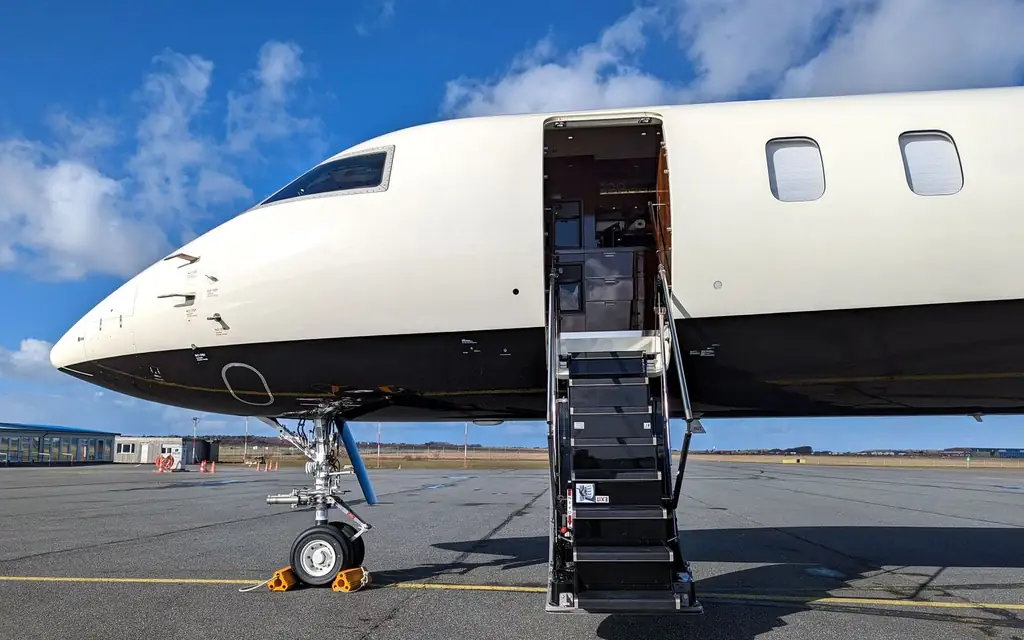
Flying with pets on a private jet is one of the main reasons some families charter at all. There is no cargo hold for the dog, no airline weight limit for a cabin pet and no crowded terminal. The animal boards with you from the FBO and sits in the cabin, subject to the operator's rules.
What a private jet does not change is the law of the country you land in. Rabies controls, microchips, health certificates and approved entry points apply to animals on private aircraft just as they do on airlines. This guide covers the operator side, the main rules for the United States, the European Union and Great Britain, and the ground transport at each end.
Can you fly with pets on a private jet?
Yes, most charter operators accept dogs and cats in the cabin with advance notice, but the decision belongs to each operator and aircraft owner. Internationally, the pet must also meet the destination country's entry rules, which typically include a microchip, a valid rabies vaccination and an official health certificate issued before departure.
Treat the operator's approval and the border rules as two separate checks. A pet friendly private jet operator can say yes to your dog in the cabin; only the destination country can say yes to your dog entering.
What charter operators usually ask
When you request a flight through our private jet charter desk, LimousineWorldwideDirectory.com acts as your booking agent and passes the request to a licensed operator, which holds operational control and sets its own policy on animals. Expect questions like these:

- Species, breed and weight of each animal.
- Whether the pet will travel in a carrier or on a lead, and where it will sit during takeoff and landing.
- Health and documents for international legs: microchip number, vaccination record and certificate.
- Behavior: whether the animal is used to flying, noise and strangers.
- Number of pets. Some aircraft or owners limit how many animals can fly at once.
Some operators charge a cleaning fee or require a protective cover on seats; others do not. Ask before you confirm, and get any pet conditions in writing on the charter agreement. Our guide to private jet etiquette explains why late surprises, including an undeclared dog, cause the most friction.
United States: bringing a dog in (or back home)
The US rules most likely to affect a private flight concern dogs and come from the Centers for Disease Control and Prevention. For dogs that have only been in countries CDC treats as dog-rabies-free or low-risk during the previous six months, CDC states the dog must be at least 6 months old on entry, must have a microchip that can be read by a universal scanner, must appear healthy, and the owner needs a receipt from the online CDC Dog Import Form; that receipt is valid for 6 months and the dog may enter through any airport, seaport or land border crossing (CDC, entry requirements for dogs from rabies-free or low-risk countries).

Dogs that have been in a high-risk country in the previous six months face stricter rules. CDC's guidance says foreign-vaccinated dogs from those countries can only enter at a US airport with a CDC-registered animal care facility where the dog has a reservation, and land border crossings are not permitted for them (CDC, dog importation FAQs). For a private flight, that can decide which US airport you are able to use, so raise it with the operator at the quote stage.
Leaving the United States with a pet
Exports are handled by the US Department of Agriculture. APHIS advises owners to contact a USDA-accredited veterinarian as soon as they decide to travel; the vet helps meet the destination's entry requirements, prepares the health certificate and submits it to APHIS for endorsement. APHIS also says owners must verify the destination country's requirements every time they travel (USDA APHIS, pet travel from the US to another country).
The same APHIS page warns that if a dog is going to or returning from a high-risk country, the CDC rabies form must be completed before departure and cannot be issued retroactively once the dog has left the US. Plan that paperwork before the return flight, not after.
European Union: dogs, cats and ferrets arriving from outside the EU
The EU publishes one set of rules for pet dogs, cats and ferrets traveling from a non-EU country. According to the EU's official Your Europe portal (Your Europe, travelling with pets):

- The pet must be microchipped before its rabies vaccination, or the vaccination is not valid.
- The first rabies vaccination can be given from 12 weeks of age, and you must wait at least 21 days after the primary vaccination before traveling.
- From most non-EU countries a rabies antibody titration test is required; after a primary vaccination it can be done 30 days later, followed by a 3-month wait from the blood sample date.
- An EU animal health certificate must be issued by an official state vet in the departure country no more than 10 days before the pet arrives.
- You can travel with up to five pets, with limited exceptions for competitions and shows.
- Entry is through a designated travellers' point of entry.
- Dogs going to Finland, Ireland, Malta, Norway or Northern Ireland need tapeworm treatment 1 to 5 days before travel.
The point of entry rule matters for private flying, because business aircraft often use smaller airfields. Ask the operator and its ground handler to confirm that your planned arrival airport works as a travellers' point of entry for pets, whether that is Paris Le Bourget or Nice Côte d'Azur.
Great Britain: approved routes and the private charter exception
Great Britain sets its own rules. GOV.UK states that pets must be microchipped before their rabies vaccination, that travel can happen at least 21 full days after the first vaccination, and that dogs must be treated for tapeworm no less than 24 hours and no more than 5 days before arriving in Great Britain. You also need a pet travel document from your vet, the type depending on the country you are coming from, and bringing more than five pets triggers additional rules unless you are attending a competition, show or sporting event (GOV.UK, bring your pet to Great Britain).
Routes are the part private flyers need to check. GOV.UK says you can only use certain travel routes and companies to enter Great Britain, that travelers from Ireland do not have to use an approved route, and that while pets generally have to travel as cargo on a plane, there is an exception if you are flying on a chartered private plane (GOV.UK, approved routes for pets). The government's list of approved air, sea, rail and charter routes can change, so the operator should confirm that its planned arrival, for example at Farnborough, is covered before the flight is fixed.
Booking the car for you and the dog? Price it here; the fare is confirmed before you pay.
Comparing the rules at a glance
| Requirement | United States (dogs, low-risk origin) | European Union (from non-EU) | Great Britain |
|---|---|---|---|
| Microchip | Required, readable by universal scanner | Required, before rabies vaccine | Required, before rabies vaccine |
| Rabies vaccination | Not listed for low-risk entry; required, with extra forms, after high-risk countries | Required; wait 21 days after primary dose | Required; wait at least 21 full days |
| Rabies titer test | Not listed for low-risk entry | Required from most non-EU countries | Check GOV.UK for your origin country |
| Health document | CDC Dog Import Form receipt | EU animal health certificate, issued within 10 days | Pet travel document from your vet |
| Tapeworm treatment | Not listed for low-risk entry | Only for Finland, Ireland, Malta, Norway, Northern Ireland | Dogs: 24 hours to 5 days before arrival |
| Entry point | Any port for low-risk dogs; restricted for some high-risk dogs | Designated travellers' point of entry | Approved route, with a private charter exception to the cargo rule |
| Pet limit | Separate form for each dog | Up to 5 (exceptions apply) | More than 5 triggers extra rules |
Rules change. Always check the official pages in the sources list for your exact route and dates, and give your vet several weeks, or months where titer tests are needed.
Planning a pet friendly car at both ends
The flight is only half the trip. A dog that waited calmly in the cabin can be stressed by a long wait on a hot ramp or a cramped back seat. When you book a private jet car service through LimousineWorldwideDirectory.com, tell the desk about the animal at booking so the local operator from our directory can confirm it accepts pets and assign a suitable vehicle.
Tips that make the transfer easier:
- Size the vehicle to the crate. A large dog in a travel crate plus luggage may need an SUV or a Sprinter van with driver rather than a sedan.
- Bring a seat cover or blanket and the pet's lead in your carry-on.
- Ask for a short stop before a long drive. From Farnborough to central London is about 56 km (35 miles), 60 to 110 minutes on a weekday, so a pause after a long flight is sensible; a London chauffeur can stay on by the hour once you arrive.
- Plan for customs time. Animals may be checked on arrival. Free waiting after international landings is 60 minutes and after domestic landings 30 minutes; tell the desk if you expect longer.
- Long drives. For a country house or ski chalet hours from the airport, a long-distance car service with planned stops is kinder to the animal than a connection.
Examples of typical transfers we plan:
- Teterboro to Midtown Manhattan: about 19 km (12 miles), 25 to 35 minutes off-peak.
- Palm Beach to Worth Avenue: about 13 to 16 km (8 to 10 miles), 15 to 30 minutes.
- Paris Le Bourget to the Étoile area: about 14 km (9 miles), 25 to 50 minutes in normal traffic; our Paris chauffeur service covers the rest of the stay.
For families who travel often with animals, our family office chauffeur service keeps the same preferences (vehicle type, crate, seat covers) on file across cities.
When flying private with a pet is not the best idea
A private jet removes many stresses, but not all. Very young puppies cannot meet the US minimum age of 6 months for dog entry described by CDC. Brachycephalic breeds and elderly animals may not cope well with any flight, private or not; ask your vet first. And if the paperwork for an international trip cannot be finished in time, it may be kinder to leave the pet with a sitter than to risk refusal of entry or quarantine on arrival. Our guide to private jet customs and immigration explains the human side of the same arrival.
Sources
- Centers for Disease Control and Prevention, Entry Requirements for Dogs from Dog-Rabies Free or Low-Risk Countries
- Centers for Disease Control and Prevention, Frequently Asked Questions on Dog Importations
- USDA APHIS, Pet Travel From the United States to Another Country
- European Union, Your Europe: Travelling with pets
- GOV.UK, Bring your pet to Great Britain
- GOV.UK, Bring your pet to Great Britain: approved routes
Frequently asked questions
Can my dog sit with me on a private jet?
Usually yes, if the operator agrees. Most operators that accept pets let them ride in the cabin, either in a carrier or on a lead, but each operator and aircraft owner sets its own policy. Declare the animal's breed and weight when you request a quote and get the pet conditions written into the charter agreement.
Do pets need a passport to fly privately?
Pets need documents rather than a passport in most cases. Depending on the destination, that means a microchip record, proof of rabies vaccination and an official health certificate or travel document. The US uses a CDC Dog Import Form receipt for dogs, the EU an animal health certificate and Great Britain a pet travel document issued by your vet.
Are there extra charges for flying with a pet?
It depends on the operator. Some charge a cleaning fee or require seat covers, and some charge nothing. Vets, laboratory tests and certificate endorsements are separate costs. Ask your broker to confirm any pet-related charges before you sign, and tell the car booking desk about the animal so the right vehicle is assigned.
Can I fly my dog into the US from abroad on a private plane?
Yes, if the dog meets CDC requirements. For dogs from rabies-free or low-risk countries, that includes being at least 6 months old, a readable microchip and a CDC Dog Import Form receipt. Dogs recently in high-risk countries face stricter rules and, in some cases, can only enter through specific airports.
Does Great Britain allow pets to arrive on private flights?
GOV.UK says pets entering Great Britain normally travel as cargo by air, with an exception for chartered private planes. You still need a microchip, rabies vaccination, the right travel document and, for dogs, tapeworm treatment between 24 hours and 5 days before arrival. Confirm the route with the operator before you fly.
What car should I book when traveling with a large dog?
Choose a vehicle with room for the crate and the luggage together, usually an SUV or a van rather than a sedan. Tell the desk about the animal when you book so the local operator can confirm it accepts pets. Bring a seat cover and the lead in your carry-on, and allow time for any checks on arrival.
Plan the rest of the trip
 Booking WorldwideOnline travel agency · our travel desk partner
Your chauffeur is booked here. Book the rest of the trip in one place: hotels, flights, resorts, activities, packages and car rentals in every country.
Plan your trip